Animals / Bird
Eurasian blue tit
Cyanistes caeruleus · Paridae
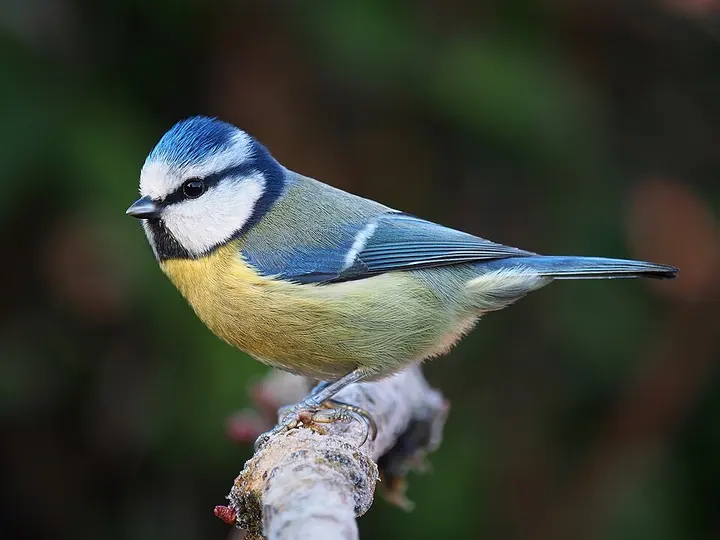
The Eurasian blue tit is a small passerine bird in the tit family, Paridae. It is easily recognised by its blue and yellow plumage and small size.
The Eurasian blue tit is a widespread and common resident breeder throughout temperate and subarctic Europe and parts of western Asia. It inhabits deciduous or mixed woodlands, often with a high proportion of oak, and it is usually non-migratory. They typically nest in tree holes but readily adapt to using nest boxes when necessary. Their main rivals for nests and in the search for food are the larger, somewhat more common great tits (Parus major). The Eurasian blue tit's diet consists mainly of insects and spiders. Outside of the breeding season, they also eat seeds and other plant-based foods. These birds are known for their acrobatic abilities; they can grip the outermost branches of trees and shrubs and hang upside down while searching for food.
Appearance
The Eurasian blue tit is usually 10.5–12 cm (4.1–4.7 in) long with a wingspan of 17.5–20 cm (6.9–7.9 in) for both sexes, and weighs about 11 g (0.39 oz). A typical blue tit has an intensely blue crown and a dark blue line passing through the eye and encircling the white cheeks and chin, giving the bird a very distinctive appearance. The forehead and a bar on the wing are white. The nape, wings and tail are blue, and the back is yellowish green.
Behaviour
Eurasian blue tits and great tits form mixed winter flocks and the former are perhaps better at balancing on slender twigs. A Eurasian blue tit often ascends a tree trunk in short, jerky hops, reminiscent of a treecreeper. The bird usually roosts in ivy or evergreens, but in harsh winters it will roost wherever it can find a suitable small hole, whether in a tree or a nesting box. They are very agile and can hang from almost anywhere.
Habitat
There are currently around 20 to 44 million pairs in Europe. The Eurasian blue tit and its hybrids are considered native species in areas of the European continent with mainly temperate or Mediterranean climates, as well as in parts of the Middle East.
Life cycle
The Eurasian blue tit will nest in any suitable hole, whether in a tree, wall, or stump, or in an artificial nest box. They often compete with house sparrows or great tits for these sites. Few birds are more likely to accept the shelter of a nesting box, and the same hole is often used year after year. When one pair dies, another takes its place. During the incubation period, the female blue tit does all of the incubating, while the male feeds her.
Where the Eurasian blue tit lives
Recorded in Sweden, France, United Kingdom, Finland, Netherlands, Germany, Norway, Spain, Denmark, Belgium, Poland and Portugal (Europe).
Most records fall in Uusimaa, Skåne, Västra Götaland, Stockholm, Finland Proper and Noord-Holland.
See the Eurasian blue tit’s range on the globe
Conservation status
Least concern (LC). Not at risk: it is doing well in the wild. Categories are the IUCN Red List as republished by GBIF.
Sources
The range is a density of 11,257,136 georeferenced GBIF records, shown on the continents where it is mainly recorded, not an expert-drawn map. Description from Wikipedia.