Animals / Mammal
Ethiopian wolf
Canis simensis · Canidae
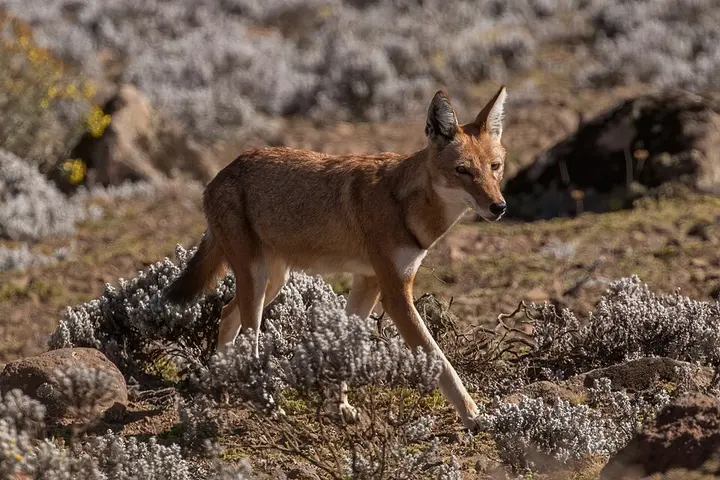
The Ethiopian wolf, also called the red jackal, the Simien jackal or Simien fox, is a canine native to the Ethiopian Highlands, including the Simien Mountains. In southeastern Ethiopia, it is also known as the horse jackal. It is similar to the coyote in size and build, and is distinguished by its long and narrow skull, and its red and white fur.
Unlike most large canids, which are widespread, generalist feeders, the Ethiopian wolf is a highly specialised feeder of Afroalpine rodents with very specific habitat requirements. It is one of the world's rarest canids, and Africa's most endangered carnivore. The species's current range is limited to seven isolated mountain ranges at altitudes of 3,000–4,500 m, with the overall adult population estimated at 360–440 individuals in 2011, more than half of them in the Bale Mountains. The Ethiopian wolf is listed as endangered by the IUCN, on account of its small numbers and fragmented range. Threats include increasing pressure from expanding human populations, resulting in habitat degradation through overgrazing, and disease transference and interbreeding from free-ranging dogs.
Appearance
The Ethiopian wolf is similar in size and build to North America's coyote; it is larger than the black-backed jackal and side-striped jackals as well as the African wolf and has comparatively longer legs. Its skull is very flat, with a long facial region accounting for 58% of the skull's total length. The ears are broad, pointed, and directed forward. The teeth, particularly the premolars, are small and widely spaced.
Behaviour
The Ethiopian wolf is a social animal, living in family groups containing up to 20 adults (individuals older than one year), though packs of six wolves are more common. Packs are formed by dispersing males and a few females, which with the exception of the breeding female, are reproductively suppressed. Each pack has a well-established hierarchy, with dominance and subordination displays being common.
Diet
In the Bale Mountains, the Ethiopian wolf's primary prey are big-headed African mole-rats, though it also feeds on grass rats, black-clawed brush-furred rats, and highland hares. Other secondary prey species include vlei rats, yellow-spotted brush-furred rats, and occasionally goslings and eggs. Ethiopian wolves have twice been observed to feed on rock hyraxes, and mountain nyala calves. It will also prey on reedbuck calves.
Habitat
The Ethiopian wolf is restricted to isolated pockets of Afroalpine grasslands and heathlands inhabited by Afroalpine rodents. Its ideal habitat extends from above the tree line around 3,200 to 4,500 m, with some wolves inhabiting the Bale Mountains being present in montane grasslands at 3,000 m. Although specimens were collected in Gojjam and northwestern Shoa at 2,500 m in the early 20th century, no recent records exist of the species occurring below 3,000 m.
Where the Ethiopian wolf lives
Recorded in Ethiopia (Africa).
Most records fall in Oromiya, Amhara and Afar.
See the Ethiopian wolf’s range on the globe
Conservation status
Endangered (EN). In danger of dying out in the wild. Categories are the IUCN Red List as republished by GBIF.
Sources
The range is a density of 150 georeferenced GBIF records, shown on the continents where it is mainly recorded, not an expert-drawn map. Description from Wikipedia.