Animals / Bird
Emu
Dromaius novaehollandiae · Dromaiidae
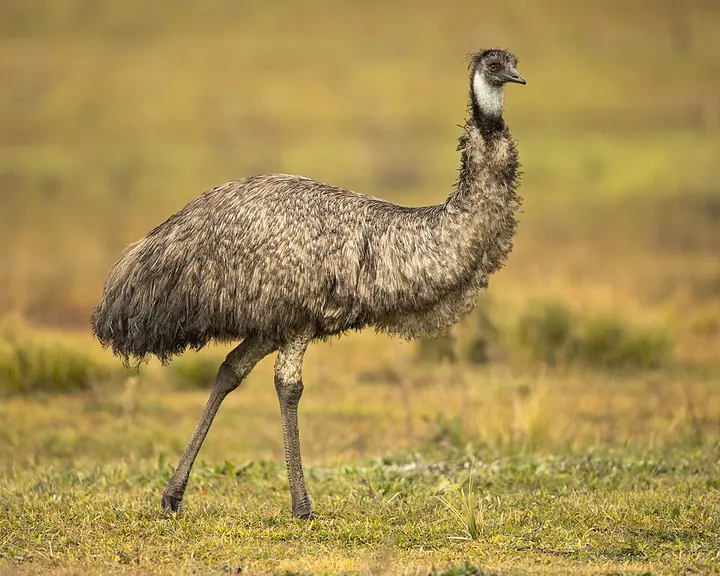
The emu is a species of flightless bird endemic to Australia, where it is the tallest native bird. It is the only extant member of the genus Dromaius and the third-tallest living bird after its African ratite relatives, the common ostrich and Somali ostrich. The emu's native ranges cover most of the Australian mainland.
The Tasmanian, Kangaroo Island and King Island subspecies became extinct after the European settlement of Australia in 1788. The emu has soft, brown feathers, a long neck, and long legs. It can grow up to 1.9 m (6 ft 3 in) in height. It is a robust bipedal runner that can travel great distances, and when necessary can sprint at 48 km/h (30 mph). It is omnivorous and forages on a variety of plants and insects, and can go for weeks without eating. It drinks infrequently, but takes in copious amounts of fresh water when the opportunity arises. Breeding takes place in May and June, and fighting among females for a mate is common. Females can mate several times and lay several clutches of eggs in one season.
Appearance
The emu is the second tallest bird in the world, only being exceeded in height by the ostrich; the largest individuals can reach up to 150 to 190 cm (59 to 75 in) in height. Measured from the bill to the tail, emus range in length from 139 to 164 cm (55 to 65 in), with males averaging 148.5 cm (58.5 in) and females averaging 156.8 cm (61.7 in).
Behaviour
Emus are diurnal birds and spend their day foraging, preening their plumage with their beak, dust bathing and resting. They are generally gregarious birds apart from the breeding season, and while some forage, others remain vigilant to their mutual benefit. They are able to swim when necessary, although they rarely do so unless the area is flooded or they need to cross a river. Emus begin to settle down at sunset and sleep during the night.
Diet
Emus forage in a diurnal pattern and eat a variety of native and introduced plant species. The diet depends on seasonal availability with such plants as Acacia, Casuarina and grasses being favoured. They also eat insects and other arthropods, including grasshoppers and crickets, beetles, cockroaches, ladybirds, bogong and cotton-boll moth larvae, ants, spiders and millipedes. This provides a large part of their protein requirements.
Habitat
Once common on the east coast of Australia, emus are now uncommon there; by contrast, the development of agriculture and the provision of water for stock in the interior of the continent have increased the range of the emu in arid regions. Emus live in various habitats across Australia both inland and near the coast.
Where the Emu lives
Recorded in Ashmore and Cartier Is. (Oceania).
Most records fall in New South Wales, South Australia, Victoria, Queensland, Western Australia and Northern Territory.
See the Emu’s range on the globe
Conservation status
Least concern (LC). Not at risk: it is doing well in the wild. Categories are the IUCN Red List as republished by GBIF.
Sources
The range is a density of 159,068 georeferenced GBIF records, shown on the continents where it is mainly recorded, not an expert-drawn map. Description from Wikipedia.