Animals / Bird
Emperor penguin
Aptenodytes forsteri · Spheniscidae
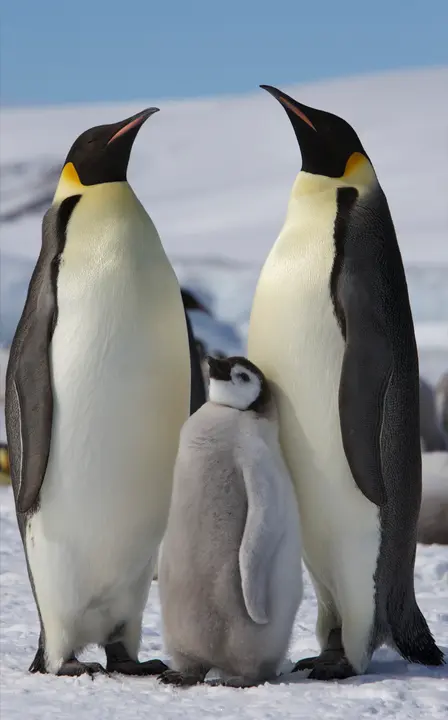
The emperor penguin is the tallest and heaviest of all living penguin species and is endemic to Antarctica. The male and female are similar in plumage and size, reaching 100 cm (39 in) in length and weighing from 22 to 45 kg. Feathers of the head and back are black and sharply delineated from the white belly, pale-yellow breast and bright-yellow ear patches.
Like all species of penguin, the emperor is flightless, with a streamlined body, and wings stiffened and flattened into flippers for a marine habitat. Its diet consists primarily of fish, but also includes crustaceans, such as krill, and cephalopods, such as squid. While hunting, the species can remain submerged around 20 minutes, diving to a depth of 535 m (1,755 ft). It has several adaptations to facilitate this, including an unusually structured haemoglobin to allow it to function at low oxygen levels, solid bones to reduce barotrauma, and the ability to reduce its metabolism and shut down non-essential organ functions.
Appearance
Adult emperor penguins are 110–120 cm (43–47 in) in length, averaging 115 cm (45 in) according to Stonehouse (1975). Due to the method of bird measurement that measures length between bill to tail, sometimes body length and standing height are confused, and some reported height even reaching 1.5 m (4 ft 11 in) tall. There are still more than a few papers mentioning that they reach a standing height of 1.2 m (3 ft 11 in) instead of body length.
Behaviour
The emperor penguin is a social animal in its nesting and its foraging behaviour; birds hunting together may coordinate their diving and surfacing. Individuals may be active day or night. A mature adult travels throughout most of the year between the breeding colony and ocean foraging areas; the species disperses into the oceans from January to March.
Diet
The emperor penguin's diet consists mainly of fish, crustaceans and cephalopods, although its composition varies from population to population. Fish are usually the most important food source, and the Antarctic silverfish (Pleuragramma antarcticum) makes up the bulk of the bird's diet.
Habitat
The emperor penguin has a circumpolar distribution in the Antarctic almost exclusively between the 66° and 77° south latitudes. It almost always breeds on stable pack ice near the coast and up to 18 km (11 mi) offshore. Breeding colonies are usually in areas where ice cliffs and icebergs provide some protection from the wind.
Where the Emperor penguin lives
Recorded in Antarctica (Antarctica).
See the Emperor penguin’s range on the globe
Conservation status
Near threatened (NT). Not at risk yet, but could be soon. Categories are the IUCN Red List as republished by GBIF.
Sources
The range is a density of 130,856 georeferenced GBIF records, shown on the continents where it is mainly recorded, not an expert-drawn map. Description from Wikipedia.