Animals / Bird
Egyptian vulture
Neophron percnopterus · Accipitridae
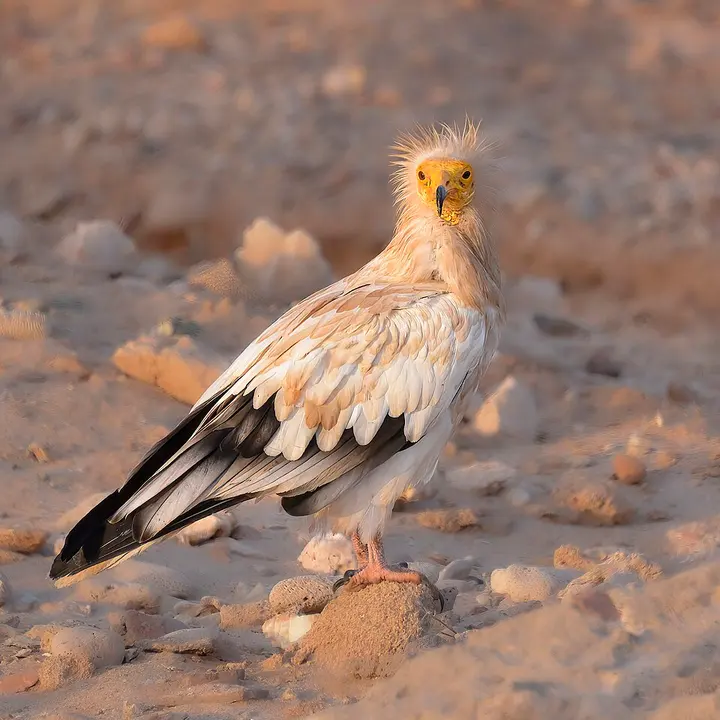
The Egyptian vulture, also called the white scavenger vulture or pharaoh's chicken, is a small Old World vulture in the monotypic genus Neophron. It is widely distributed from the Iberian Peninsula, North Africa, West Asia and India. The contrasting underwing pattern and wedge-shaped tail make it distinctive in flight as it soars in thermals during the warmer parts of the day.
Egyptian vultures feed mainly on carrion but are opportunistic and will prey on small mammals, birds, and reptiles. They also feed on the eggs of other birds, breaking larger ones by tossing a large pebble onto them. The use of tools is rare in birds and apart from the use of a pebble as a hammer, Egyptian vultures also use twigs to roll up wool for use in their nest. Egyptian vultures that breed in the temperate regions migrate south in winter while tropical populations are relatively sedentary. Populations of this species declined in the 20th century and some island populations are endangered by hunting, accidental poisoning, and collision with power lines.
Appearance
The adult's plumage is white, with black flight feathers in the wings. Wild birds usually appear soiled with a rusty or brown shade to the white plumage, derived from mud or iron-rich soil. Captive specimens without access to soil have clean white plumage. It has been suggested as a case of cosmetic colouration. The bill is slender and long, and the tip of the upper mandible is hooked. The nostril is an elongated horizontal slit. The neck feathers are long and form hackles.
Behaviour
The Egyptian vulture is usually seen singly or in pairs, soaring in thermals along with other scavengers and birds of prey, or perched on the ground or atop a building. On the ground, they walk with a waddling gait. They feed on a range of food, including mammal faeces (including those of humans), insects in dung, carrion, vegetable matter, and sometimes small animals. It is the only Old World vulture species that regularly feeds on faeces.
Life cycle
The breeding season is in spring. During the beginning of the breeding season, courting pairs soar high together and one or both may make steep spiralling or swooping dives. The birds are monogamous and pair bonds may be maintained for more than one breeding season and the same nest sites may be reused each year. The nest is an untidy platform of twigs lined with rags and placed on a cliff ledge, building, or the fork of a large tree.
Where the Egyptian vulture lives
Recorded in Spain, India, France, Israel, Portugal, United Arab Emirates and Turkey (Europe and Asia).
Most records fall in Rajasthan, Cáceres, HaDarom, Huesca, Cádiz and Las Palmas.
See the Egyptian vulture’s range on the globe
Conservation status
Endangered (EN). In danger of dying out in the wild. Categories are the IUCN Red List as republished by GBIF.
Sources
The range is a density of 188,367 georeferenced GBIF records, shown on the continents where it is mainly recorded, not an expert-drawn map. Description from Wikipedia.