Animals / Mammal
Eastern grey kangaroo
Macropus giganteus · Macropodidae
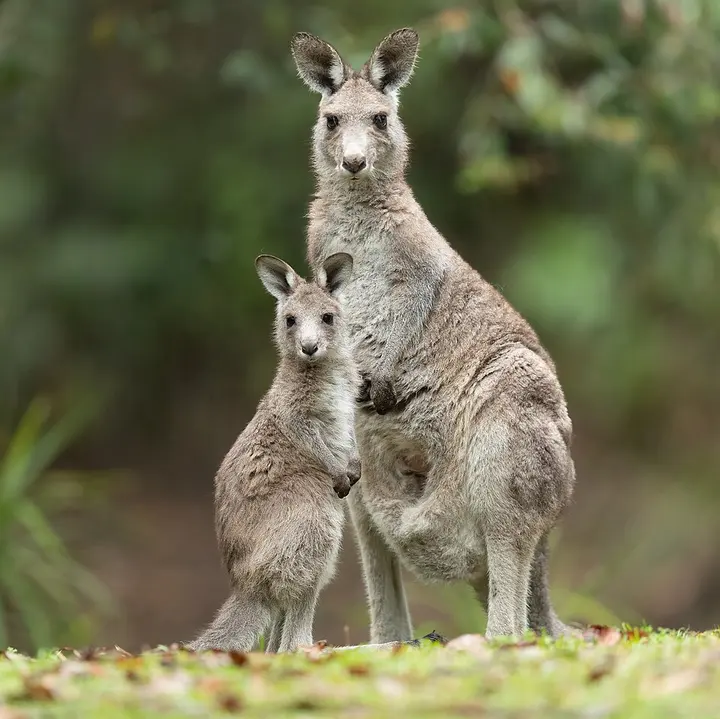
The eastern grey kangaroo is a marsupial found in the eastern third of Australia, with a population of several million. A large M. giganteus kangaroo male can typically weigh up to 69 kg (152 lb) and have a length of well over 2 m.
Appearance
The eastern grey kangaroo is the second largest and heaviest living marsupial and native land mammal in Australia. An adult male will commonly weigh around 50 to 66 kg (110 to 146 lb) whereas females commonly weigh around 17 to 40 kg (37 to 88 lb). They have a powerful tail that is over 1 m (3 ft 3 in) long in adult males. One of these, shot in eastern Tasmania weighed 82 kg (181 lb), with a 2.64 m (8 ft 8 in) total length from nose to tail (possibly along the curves).
Behaviour
Like all kangaroos, it is mainly nocturnal and crepuscular, and is mostly seen early in the morning, or as the light starts to fade in the evening. In the middle of the day, kangaroos rest in the cover of the woodlands and eat there but then come out in the open to feed on the grasslands in large numbers.
Habitat
Although the red is better known, the eastern grey is the kangaroo most often encountered in Australia, due to its adaptability. Few Australians visit the arid interior of the continent, while many live in and around the major cities of the southern and eastern coast, from where it is usually only a short drive to the remaining pockets of near-city bushland where kangaroos can be found without much difficulty.
Life cycle
Eastern grey kangaroos are polygynous which means that one male mates with multiple females. Males do a lot of intraspecific competition for mates which includes male-male fights to determine dominance between the two males. When a dominant male finds a female in estrus, he will court the female and eventually they copulate. After copulation, the male will guard the female from other males.
Where the Eastern grey kangaroo lives
Recorded in Ashmore and Cartier Is. (Oceania).
Most records fall in New South Wales, Victoria, Australian Capital Territory, Queensland and Tasmania.
See the Eastern grey kangaroo’s range on the globe
Conservation status
Least concern (LC). Not at risk: it is doing well in the wild. Categories are the IUCN Red List as republished by GBIF.
Sources
The range is a density of 226,061 georeferenced GBIF records, shown on the continents where it is mainly recorded, not an expert-drawn map. Description from Wikipedia.