Animals / Mammal
Eastern gray squirrel
Sciurus carolinensis · Sciuridae
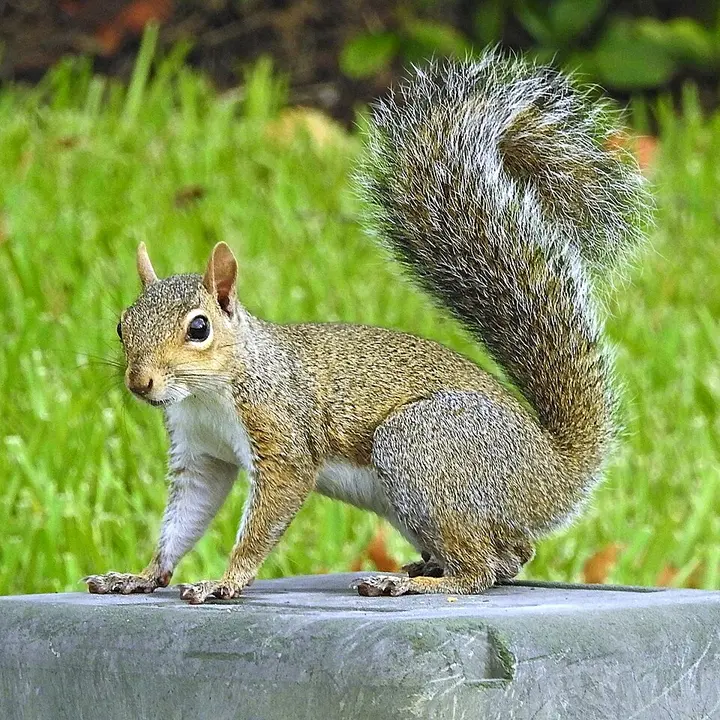
The eastern gray squirrel, spelled as grey squirrel outside of the United States, is a species of tree squirrel in the genus Sciurus. It is native to eastern North America, where it is the most prodigious and ecologically essential natural forest regenerator. Widely introduced to certain places around the world, the eastern gray squirrel in Europe, in particular, is regarded as an invasive species.
In Europe, Sciurus carolinensis is included (since 2016) in the list of Invasive Alien Species of Union concern (the Union list). This implies that this species cannot be imported, bred, transported, commercialized, or intentionally released into the environment in the whole of the European Union.
Appearance
The eastern gray squirrel has predominantly gray fur with brown spots and streaks. It has a white underside as compared to the brownish-orange underside of the fox squirrel; both exhibit countershading. It has a large bushy tail. Particularly in urban situations where the risk of predation is reduced, both white-colored and black-colored individuals are quite often found.
Behaviour
The eastern gray squirrel is one of very few mammalian species that can descend a tree head-first. It does this by turning its feet so the claws of its hind paws are backward-pointing and can grip the tree bark. Eastern gray squirrels build a type of nest, known as a drey, in the forks of trees, consisting mainly of dry leaves and twigs.
Diet
Eastern gray squirrels eat a range of foods, such as many types of seeds and nuts, including acorns, walnuts, and hazelnuts, bulbs, tree buds, flowers, berries, other fruits, tree bark, and some types of forest fungi, including fly agaric mushrooms and truffles. They are also carnivorous, variously eating insects, small birds, eggs, frogs, lizards, and other small rodents, including other squirrels.
Habitat
Sciurus carolinensis is native to the eastern and midwestern United States, and to the southerly portions of the central provinces of Canada. In the mid-1800s, the population in the midwestern United States was described as being "truly astonishing," but human predation and habitat destruction through deforestation resulted in drastic population reductions, to the point that the animal was almost absent from Illinois by 1900.
Life cycle
Eastern gray squirrels can breed twice a year, but younger and less experienced mothers normally have a single litter per year in the spring. Depending on forage availability, older and more experienced females may breed again in summer. In a year of abundant food, 36% of females bear two litters, but none will do so in a year of poor food.
Where the Eastern gray squirrel lives
Recorded in United States of America and Canada (Europe and North America).
Introduced, not native, in United Kingdom.
Most records fall in Florida, Ontario, Dumfries and Galloway, New York, Virginia and Massachusetts.
See the Eastern gray squirrel’s range on the globe
Conservation status
Least concern (LC). Not at risk: it is doing well in the wild. Categories are the IUCN Red List as republished by GBIF.
Sources
The range is a density of 718,743 georeferenced GBIF records, shown on the continents where it is mainly recorded, not an expert-drawn map. Description from Wikipedia.