Animals / Mammal
Eastern cottontail
Sylvilagus floridanus · Leporidae
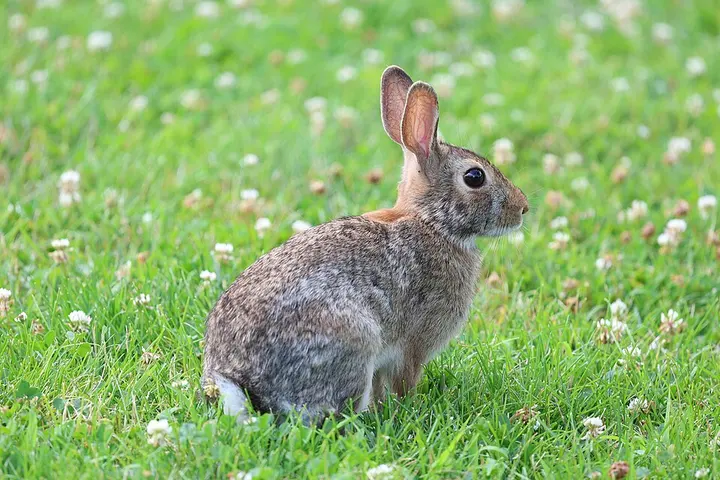
The eastern cottontail is a species of rabbit in the family Leporidae. It is the most widespread and abundant rabbit species in North America, inhabiting a wide range that extends from southern Canada throughout most of the United States and into parts of Mexico, Central America, and the northern regions of South America. Known for its distinctive fluffy white tail, which resembles a cotton ball and gives the species its common name, the eastern cottontail typically inhabits open fields, meadows, and brushy areas where it can easily find cover and food.
It is a primarily herbivorous, crepuscular mammal that feeds on grasses, herbs, twigs, and bark, and plays an important role in the ecosystem as prey for a variety of predators including foxes, hawks, and owls. Due to its adaptability to human-altered landscapes such as suburban and agricultural areas, the eastern cottontail has maintained stable population levels and is not considered threatened. It is also well known for its high reproductive rate, with females capable of producing multiple large litters annually, which contributes to its widespread presence.
Appearance
The eastern cottontail has a distinctive white spot on its forehead when young and fur that ranges from reddish-brown to grayish-brown, with large hind feet, long ears, and a short, fluffy white tail. Its underside is white, and there is a rusty patch near the tail. It differs from a hare in its overall smaller size and brownish-gray coloring around the head and neck, with a lighter-colored body and a white underside on the tail.
Behaviour
The eastern cottontail is a territorial species that relies on speed and agility to evade predators. When chased, it typically escapes in a zigzag pattern and can reach speeds of up to 18 mph (29 km/h). Cottontails favor habitats where they can feed in the open but quickly retreat to cover when threatened. Preferred environments include forest edges, swamps, brushy thickets, hedgerows, and open fields with nearby shelter.
Diet
Eastern cottontails feed primarily on a wide variety of plants, with some studies documenting 70–145 plant species in their diet. They prefer tender herbaceous vegetation, such as grasses, clovers (Trifolium spp.), crabgrasses (Digitaria spp.), and wild rye (Elymus spp.).
Life cycle
Eastern cottontails reach sexual maturity at 2–3 months of age. Breeding season varies by latitude and climate, beginning as early as January in the southern United States and around March in New England, continuing through late summer. Mating is promiscuous, with males competing for access to females. The nest is typically a slanted hole in soft soil lined with fur and grasses, measuring about 7.1 in × 4.9 in × 4.7 in (18 cm × 12 cm × 12 cm).
Where the Eastern cottontail lives
Recorded in United States of America, Canada and Mexico (North America).
Most records fall in Texas, Ontario, Massachusetts, Illinois, New York and Pennsylvania.
See the Eastern cottontail’s range on the globe
Conservation status
Least concern (LC). Not at risk: it is doing well in the wild. Categories are the IUCN Red List as republished by GBIF.
Sources
The range is a density of 152,257 georeferenced GBIF records, shown on the continents where it is mainly recorded, not an expert-drawn map. Description from Wikipedia.