Animals / Mammal
Eastern chipmunk
Tamias striatus · Sciuridae
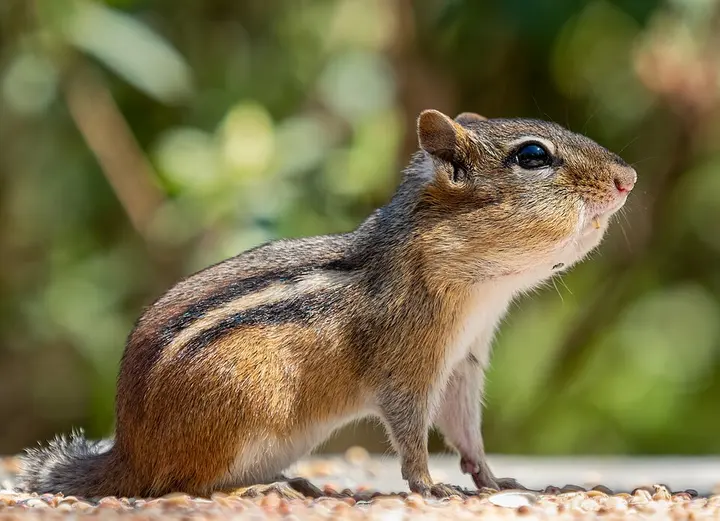
The eastern chipmunk is a chipmunk species found in eastern North America. It is the only living member of the genus Tamias.
Appearance
A small species, it reaches about 30 cm (12 in) in length including the tail, and a weight of 66–150 g (2.3–5.3 oz). It has reddish-brown fur on its upper body and five dark brown stripes contrasting with light brown stripes along its back, ending in a dark tail. It has lighter fur on the lower part of its body. It has a tawny stripe that runs from its whiskers to below its ears, and light stripes over its eyes.
Behaviour
The eastern chipmunk can climb trees well, but constructs underground nests with extensive tunnel systems, often with several entrances. To hide the construction of it(s) burrow, the eastern chipmunk is argued by some to carry soil to a different location in its cheek pouches. However, recorded observations of chipmunks carrying soil in their cheek pouches are extremely limited.
Diet
The chipmunk is mainly active during the day, spending most of its day foraging. It prefers bulbs, seeds, fruits, nuts, green plants, mushrooms, insects, worms, and bird eggs. It commonly transports food in pouches in its cheeks.
Habitat
The eastern chipmunk lives in deciduous wooded areas and urban parks throughout the eastern United States and southern Canada. It prefers locations with rocky areas, brush or log piles, and shrubs to provide cover.
Life cycle
The eastern chipmunk defends its burrow and lives a solitary life, except during mating season. In fact, the chipmunk's solitary existence has been noted by author and scientist Lawrence Wishner as "one of the most characteristic behavioral features of the chipmunk". Members of the species interact with each other only while courting and mating, and for the period that pups spend with their mothers after birth, typically around six to eight weeks.
Where the Eastern chipmunk lives
Recorded in United States of America and Canada (North America).
Most records fall in Ontario, New York, Massachusetts, Québec, Michigan and Pennsylvania.
See the Eastern chipmunk’s range on the globe
Conservation status
Least concern (LC). Not at risk: it is doing well in the wild. Categories are the IUCN Red List as republished by GBIF.
Sources
The range is a density of 95,518 georeferenced GBIF records, shown on the continents where it is mainly recorded, not an expert-drawn map. Description from Wikipedia.