Animals / Bird
Eastern bluebird
Sialia sialis · Turdidae
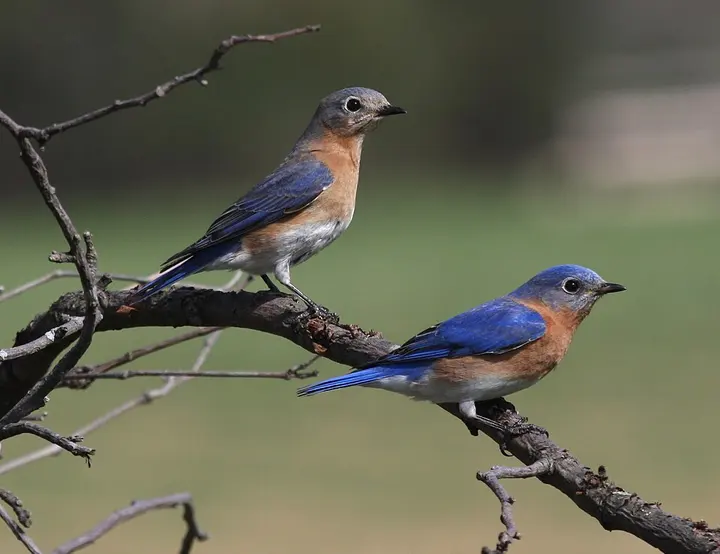
The eastern bluebird is a small North American migratory thrush found in open woodlands, farmlands, and orchards.
The bright-blue breeding plumage of the male, easily observed on a wire or open perch, makes this species a favorite of birders. The male's call includes sometimes soft warbles of jeew or chir-wi, or the melodious song chiti WEEW wewidoo. It is the state bird of Missouri and New York.
Appearance
Eastern bluebirds measure 16–21 cm (6.3–8.3 in) long, span 25–32 cm (9.8–12.6 in) across the wings, and weigh 27–34 g (0.95–1.20 oz). Male bluebirds have a bright head, back, and wings. Their breast is a brownish red. Females are lighter with gray on the head and back and some blue on their wings and tail. In females, the breast is usually lighter in color than in males, and is more orange.
Behaviour
Eastern bluebirds are social, and will sometimes gather in flocks of over a hundred. However, they are territorial during the breeding season and may continue to defend a feeding area throughout the winter.
Habitat
The eastern bluebird is found east of the Rockies, southern Canada to the Gulf states, and southeastern Arizona to Nicaragua. The increase in trees throughout the Great Plains during the past century due to fire suppression and tree planting facilitated the western range expansion of the species. as well as range expansions of many other species of birds.
Life cycle
Mating occurs in the spring and summer. A mature female typically raises two broods each season. Nests are constructed in trees within abandoned woodpecker holes or other cavities that provide adequate protection (usually several feet above ground). Construction of the nest is done primarily by the female and takes around 10 days to complete. These nests are small, cup-like structures lined with grass, feathers, stems, and hairs.
Where the Eastern bluebird lives
Recorded in United States of America and Canada (North America).
Most records fall in Virginia, North Carolina, Pennsylvania, Maryland, Texas and Georgia.
See the Eastern bluebird’s range on the globe
Conservation status
Least concern (LC). Not at risk: it is doing well in the wild. Categories are the IUCN Red List as republished by GBIF.
Sources
The range is a density of 8,088,378 georeferenced GBIF records, shown on the continents where it is mainly recorded, not an expert-drawn map. Description from Wikipedia.