Animals / Mammal
East African oryx
Oryx beisa · Bovidae
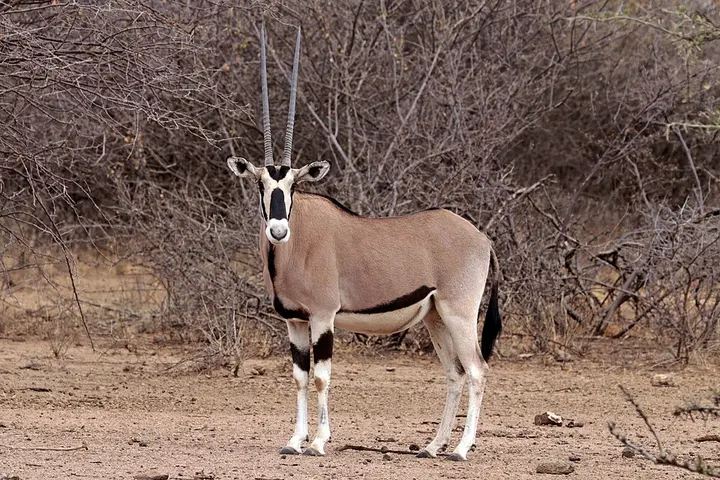
The East African oryx, also known as the beisa, is a species of medium-sized antelope from East Africa. It has two subspecies: the common beisa oryx found in steppe and semidesert throughout the Horn of Africa Somalia and north of the Tana River, and the fringe-eared oryx south of the Tana River in southern Kenya Somalia and parts of Tanzania. The species is listed as Endangered by the IUCN.
In the past, some taxonomists considered it a subspecies of the gemsbok (Oryx gazella), but they are genetically distinct; the diploid chromosome count is 56 for the beisa and 58 for the gemsbok.
Appearance
The East African oryx stands between 0.79 and 1.25 m (2.6 and 4.1 ft) tall at the shoulder and typically weighs between 220 and 460 lb (100 and 209 kg). It has a grey coat with a white underside, separated from the grey by a stripe of black, with black stripes where the head attaches to the neck, along the nose, and from the eye to the mouth and on the forehead. The mane is small and chestnut-coloured; the ringed horns are thin and straight.
Behaviour
East African oryx live in semidesert and steppes, where they eat grasses, leaves, fruit and buds. During periods of dehydration, they limit water losses by allowing their body temperatures to increase (so as to avoid perspiration). They gather in herds of five to 40 animals, often with females moving at the front and a large male guarding from the rear. Some older males are solitary.
Where the East African oryx lives
Recorded in Kenya, Ethiopia and Tanzania (Africa).
Most records fall in Eastern, Rift Valley, Coast, Afar, Oromiya and Arusha.
See the East African oryx’s range on the globe
Conservation status
Endangered (EN). In danger of dying out in the wild. Categories are the IUCN Red List as republished by GBIF.
Sources
The range is a density of 1,007 georeferenced GBIF records, shown on the continents where it is mainly recorded, not an expert-drawn map. Description from Wikipedia.