Animals / Amphibian
Dyeing poison dart frog
Dendrobates tinctorius · Dendrobatidae
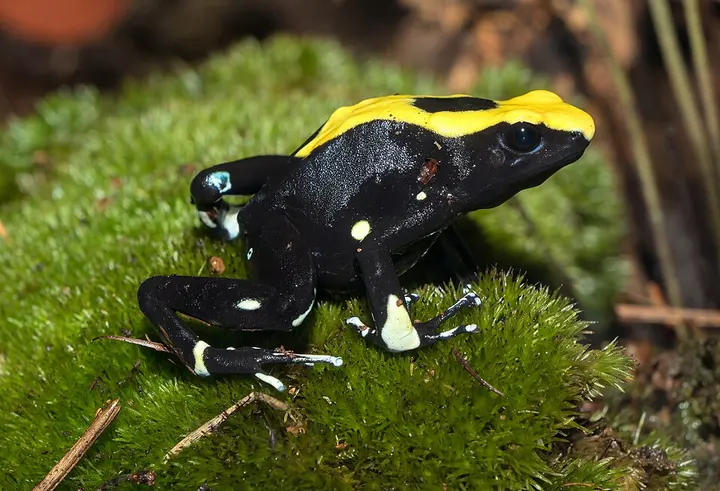
The cobalt dyeing poison dart frog, also known as the cobalt poison frog, tinc, is a species of poison dart frog. It is among the most variably colored and largest species of poison dart frogs, typically reaching snout–vent lengths of about 50 mm (2.0 in). It is distributed in the eastern portion of the Guiana Shield, including parts of French Guiana, Guyana, Suriname, and Brazil.
These types of frogs usually tend to stay on the ground as it is easier to catch prey., though in some cases may climb trees as well. They are frequently found in treefall canopy gaps in the Amazon rainforest, as they utilize phytotelmata on the fallen trees for tadpole development.
Appearance
The dyeing poison dart frog is large for a poison dart frog, but may be smaller than Phyllobates terribilis and Ameerega trivittata. Small forms of D. tinctorius reach 3.5 cm (1.4 in) in snout–vent length; most variants are around 5 cm (2.0 in) in length or slightly bigger; some of the largest variants may reach 7 cm (2.8 in).
Habitat
The dyeing poison dart frog exists in discrete patches of the eastern Guiana Shield, being found at altitudes up to 600 m (2,000 ft). It is found in regions of tropical primary rainforests, but is associated with areas with canopy gaps. It is mostly found in upland areas, for example in hills or at the base of mountains, but populations are also present at sea level. Erosion of the highlands has contributed to creating isolate populations.
Where the Dyeing poison dart frog lives
Recorded in Suriname and Brazil (South America).
Most records fall in Sipaliwini, Amapá and Pará.
See the Dyeing poison dart frog’s range on the globe
Conservation status
Least concern (LC). Not at risk: it is doing well in the wild. Categories are the IUCN Red List as republished by GBIF.
Sources
The range is a density of 637 georeferenced GBIF records, shown on the continents where it is mainly recorded, not an expert-drawn map. Description from Wikipedia.