Animals / Mammal
Dugong
Dugong dugon · Dugongidae
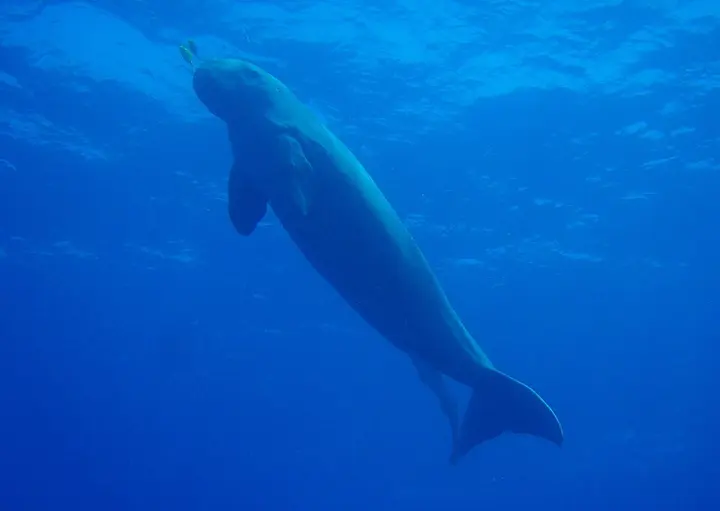
The dugong is a marine mammal. It is one of four living species of the order Sirenia, which also includes three species of manatees. It is the only living representative of the once-diverse family Dugongidae; its closest modern relative, Steller's sea cow, was hunted to extinction in the 18th century.
The dugong is the only sirenian in its range, which spans the waters of some 40 countries and territories throughout the Indo-West Pacific. The dugong is largely dependent on seagrass communities for subsistence and is thus restricted to the coastal habitats that support seagrass meadows, with the largest dugong concentrations typically occurring in wide, shallow, protected areas, such as bays, mangrove channels, the waters of large inshore islands, and inter-reefal waters. The northern waters of Australia between Shark Bay and Moreton Bay are believed to be the dugong's contemporary stronghold. Like all modern sirenians, the dugong has a fusiform body with no dorsal fin or hind limbs. The forelimbs or flippers are paddle-like.
Appearance
The dugong's body is large with a cylindrical shape that tapers at both ends. It has thick, smooth skin that is a pale cream colour at birth but darkens dorsally and laterally to brownish-to-dark-grey with age. The colour of a dugong can change due to the growth of algae on the skin. An adult's length rarely exceeds 3 metres (10 ft). An individual this long is expected to weigh around 420 kilograms (930 lb).
Diet
Dugongs, along with other sirenians, are referred to as "sea cows" because their diet consists mainly of seagrass, particularly the genera Halophila and Halodule. When eating they ingest the whole plant, including the roots, although when this is impossible they will feed on just the leaves. A wide variety of seagrass has been found in dugong stomach contents, and evidence exists they will eat algae when seagrass is scarce.
Habitat
Dugongs are found in warm coastal waters from the western Pacific Ocean to the eastern coast of Africa, along an estimated 140,000 kilometres (87,000 mi) of coastline between 26° and 27° to the north and south of the equator. Their historic range is believed to correspond to that of seagrasses from the Potamogetonaceae and Hydrocharitaceae families.
Where the Dugong lives
Recorded in Ashmore and Cartier Is., New Caledonia, Papua New Guinea and Vanuatu (Oceania).
Most records fall in Queensland, Northern Territory, Western Australia, Sud, Nord and Western.
See the Dugong’s range on the globe
Conservation status
Vulnerable (VU). At risk: it could become endangered. Categories are the IUCN Red List as republished by GBIF.
Sources
The range is a density of 29,107 georeferenced GBIF records, shown on the continents where it is mainly recorded, not an expert-drawn map. Description from Wikipedia.