Animals / Mammal
Desert warthog
Phacochoerus aethiopicus · Suidae
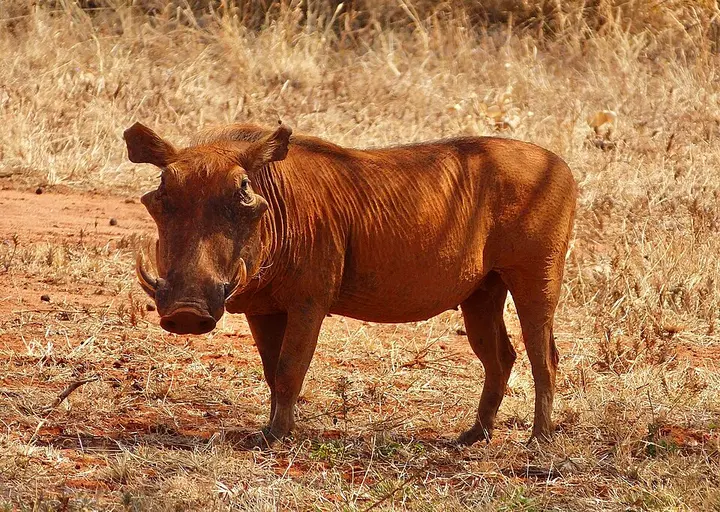
The desert warthog is a mammalian, artiodactyl-ungulate species of the pig and swine family (Suidae) native to the Horn of Africa region of East Africa. Two subspecies have been named: the Cape warthog, which became extinct around 1865, had once inhabited South Africa, while the extant Somali warthog is largely found in Kenya and Somalia, some areas of Ethiopia, and potentially still inhabits parts of Djibouti and Eritrea.
Appearance
The desert warthog is a stockily built animal growing to an average length of 125 centimetres (49 in) and weight of 75 kilograms (165 lb), with males being larger than females. It has a rather flattened head with distinctive facial paired protuberances ("warts") and large curving canine teeth that protrude as tusks. These are not present in juveniles, but grow over the course of a few years. They are larger in males than in females.
Behaviour
Desert warthogs live in social groups called "sounders", consisting mostly of females and their offspring, while males tend to live in solitude or form bachelor groups. A sounder occupies a home range of about 10 square kilometres (3.9 sq mi), which is usually centred on a water hole. The warthogs dig a number of burrows, or take over holes excavated by other animals, and move from one to another.
Habitat
The desert warthog is native to the Horn of Africa. Its current range extends from southeastern Ethiopia through western Somalia to eastern and central Kenya. The subspecies P. a. aethiopicus, commonly known as the Cape warthog, once occurred in the southeastern parts of Cape Province and the adjacent parts of Natal Province, but became extinct around 1871.
Where the Desert warthog lives
Recorded in Kenya, Benin, Dem. Rep. Congo, Somalia, Ethiopia and Tanzania (Africa).
Most records fall in Plateau, Eastern, Rift Valley, Coast, Katanga and Collines.
See the Desert warthog’s range on the globe
Conservation status
Least concern (LC). Not at risk: it is doing well in the wild. Categories are the IUCN Red List as republished by GBIF.
Sources
The range is a density of 738 georeferenced GBIF records, shown on the continents where it is mainly recorded, not an expert-drawn map. Description from Wikipedia.