Animals / Bird
Dark-eyed junco
Junco hyemalis · Passerellidae
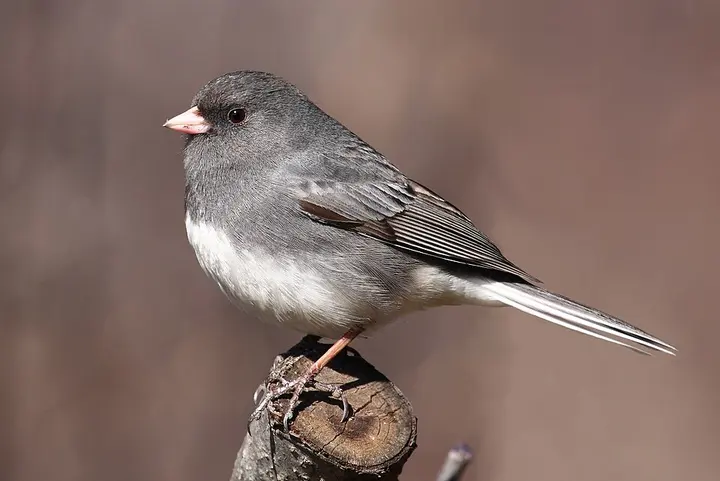
The dark-eyed junco is a species of junco, a group of small, grayish New World sparrows. The species is common across much of temperate North America and in summer it ranges far into the Arctic. It is a variable species, much like the related fox sparrow, and its systematics are still not completely resolved.
Appearance
Adult dark-eyed juncos generally have gray heads, necks, and breasts, gray or brown backs and wings, and a white belly, but show a confusing amount of variation in plumage details. The white outer tail feathers flash distinctively in flight and while hopping on the ground. The bill is usually pale pinkish.Males tend to have darker, more conspicuous markings than females.
Behaviour
These birds forage on the ground. In winter, they often forage in flocks that may contain several different subspecies. They mainly eat seeds and insects, with seeds comprising three quarters of their year-round diet. However, during the breeding season, insects comprise nearly half of the diet of adult dark-eyed juncos. Young dark-eyed juncos also depend on a diet of mainly insects. A flock of dark-eyed juncos has been known to be called a blizzard.
Habitat
The dark-eyed junco's breeding habitat is coniferous or mixed forest areas throughout North America. In otherwise optimal conditions it also utilizes other habitats, but at the southern margin of its range it can only persist in its favorite habitat. Northern birds migrate further south, arriving in their winter quarters between mid-September and November and leaving to breed from mid-March onwards, with almost all of them gone by the end of April or so.
Life cycle
Dark-eyed juncos usually nest in a cup-shaped depression on the ground, well-hidden by vegetation or other material, although nests are sometimes found in the lower branches of a shrub or tree. The nests have an outer diameter of about 10 cm (3.9 in) and are lined with fine grasses and hair. Normally, two clutches of four eggs are laid during the breeding season.
Where the Dark-eyed junco lives
Recorded in United States of America and Canada (North America).
Most records fall in California, Washington, New York, Ontario, Oregon and Québec.
See the Dark-eyed junco’s range on the globe
Conservation status
Least concern (LC). Not at risk: it is doing well in the wild. Categories are the IUCN Red List as republished by GBIF.
Sources
The range is a density of 14,859,932 georeferenced GBIF records, shown on the continents where it is mainly recorded, not an expert-drawn map. Description from Wikipedia.