Animals / Starfish
Crown-of-thorns starfish
Acanthaster planci · Acanthasteridae
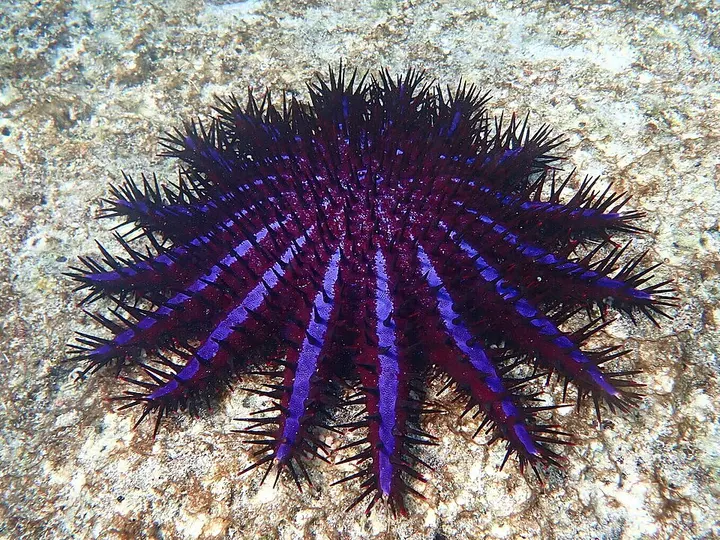
The crown-of-thorns starfish is a large starfish that preys upon hard coral polyps. The crown-of-thorns starfish, frequently abbreviated to COTS, receives its name from venomous, thornlike spines that cover its upper surface, resembling the biblical crown of thorns. It is one of the largest starfish in the world.
A. planci has a very wide Indo-Pacific distribution, perhaps most common around Australia, but can occur at tropical and subtropical latitudes from the Red Sea and the East African coast across the Indian Ocean, and across the Pacific Ocean to the west coast of Central America. It occurs where coral reefs or hard coral communities occur in the region. Echinobase is the model organism database for A. planci and a number of other echinoderms.
Appearance
The body form of the crown-of-thorns starfish is fundamentally the same as that of a typical starfish, with a central disc and radiating arms. Its special traits, however, include being disc-shaped, multiple-armed, flexible, prehensile, and heavily spined, and having a large ratio of stomach surface to body mass. Its prehensile ability arises from the two rows of numerous tube feet that extend to the tip of each arm.
Behaviour
A. planci is one of the most efficient predators on scleractinias (stony corals or hard corals). Most coral-feeding organisms only cause tissue loss or localized injuries, but adults of A. planci can kill entire coral colonies. In 1960-1965, marine scientist Robert Endean reported high densities of A. planci on the Great Barrier Reef..
Diet
The adult crown-of-thorns is a corallivorous predator that usually preys on reef scleractinian coral polyps, as well as encrusting sessile invertebrates and dead animals. It climbs onto a section of living coral colony using the large number of tube feet, which lie in distinct ambulacral grooves on the oral surface. It fits closely to the surface of the coral, even the complex surfaces of branching corals.
Life cycle
A 200-mm-diameter female produces 0.5–2.5 million eggs, representing 2–8% of her wet weight. A 300-mm-diameter female produces 6.5–14 million eggs, representing 9–14% of her wet weight. A 400-mm-diameter female produces 47–53 million eggs, representing 20–25% of her wet weight. In coral reefs in the Philippines, female specimens were found with a gonadosomatic index (ratio of gonad mass to body mass) as high as 22%, which underlines the high fecundity of this starfish.
Where the Crown-of-thorns starfish lives
Recorded in Ashmore and Cartier Is., Fr. Polynesia, Mexico, United States of America, New Caledonia, Fiji, Indonesia, Thailand, Philippines, Solomon Is., Micronesia, Maldives and Papua New Guinea (Oceania, North America, Asia and Seven seas (open ocean)).
Most records fall in Windward Islands, Queensland, Hawaii, Sud, Baja California Sur and Western.
See the Crown-of-thorns starfish’s range on the globe
Conservation status
Not evaluated (NE). Scientists haven’t checked yet how at risk it is, so this doesn’t mean it is safe or in danger. Categories are the IUCN Red List as republished by GBIF.
Sources
The range is a density of 5,111 georeferenced GBIF records, shown on the continents where it is mainly recorded, not an expert-drawn map. Description from Wikipedia.