Animals / Mammal
Coyote
Canis latrans · Canidae
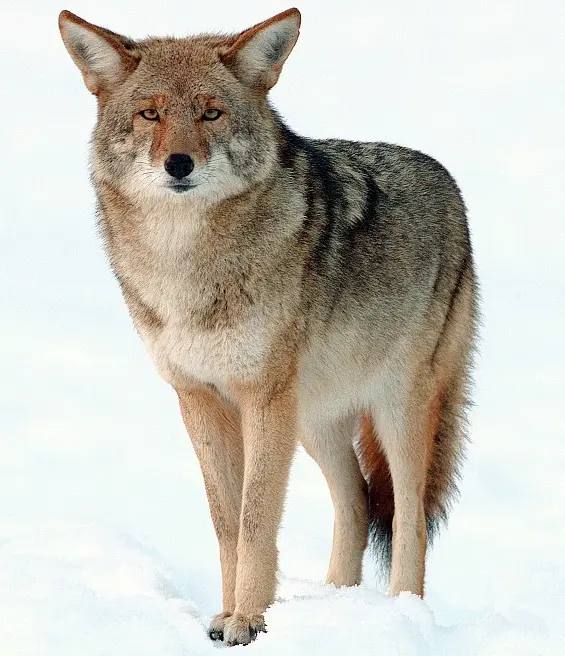
The coyote is a species of canine also known as the American jackal, prairie wolf, and brush wolf. It is native to North America, and it is smaller than its close relative, the gray wolf, and slightly smaller than the closely related eastern wolf and red wolf. It fills much of the same ecological niche as the golden jackal does in Eurasia, but the coyote is generally larger.
The coyote is listed as least concern by the International Union for Conservation of Nature, due to its wide distribution and abundance throughout North America. The species is versatile, able to adapt to and expand into environments modified by humans; urban coyotes are common in many cities. The coyote was sighted in eastern Panama (across the Panama Canal from their home range) for the first time in 2013. The coyote has 19 recognized subspecies. The average male weighs 8 to 20 kg (18 to 44 lb) and the average female 7 to 18 kg (15 to 40 lb). Their fur color is predominantly light gray and red or fulvous interspersed with black and white, though it varies somewhat with geography.
Appearance
Coyote males average 8 to 20 kg (18 to 44 lb) in weight, while females average 7 to 18 kg (15 to 40 lb), though size varies geographically. Northern subspecies, which average 18 kg (40 lb), tend to grow larger than the southern subspecies of Mexico, which average 11.5 kg (25 lb). Total length ranges on average from 1.0 to 1.35 m (3 ft 3 in to 4 ft 5 in); comprising a tail length of 40 cm (16 in), with females being shorter in both body length and height.
Behaviour
Like the Eurasian golden jackal, the coyote is gregarious, but not as dependent on conspecifics as more social canid species like wolves are. This is likely because the coyote is not a specialized hunter of large prey as the latter species is. The basic social unit of a coyote pack is a family containing a reproductive female. However, unrelated coyotes may join forces for companionship, or to bring down prey too large to attack on their own.
Diet
The coyote is ecologically the North American equivalent of the Eurasian golden jackal. Likewise, the coyote is highly versatile in its choice of food, but is primarily carnivorous, with 90% of its diet consisting of meat.
Habitat
Prior to the near extermination of wolves and cougars, the coyote was most numerous in grasslands inhabited by bison, pronghorn, elk, and other deer, doing particularly well in short-grass areas with prairie dogs, though it was just as much at home in semiarid areas with sagebrush and jackrabbits or in deserts inhabited by cactus, kangaroo rats, and rattlesnakes.
Where the Coyote lives
Recorded in United States of America, Canada and Mexico (North America).
Most records fall in California, Texas, Ontario, Arizona, Alberta and New Mexico.
See the Coyote’s range on the globe
Conservation status
Least concern (LC). Not at risk: it is doing well in the wild. Categories are the IUCN Red List as republished by GBIF.
Sources
The range is a density of 107,713 georeferenced GBIF records, shown on the continents where it is mainly recorded, not an expert-drawn map. Description from Wikipedia.