Animals / Mammal
Cougar
Puma concolor · Felidae
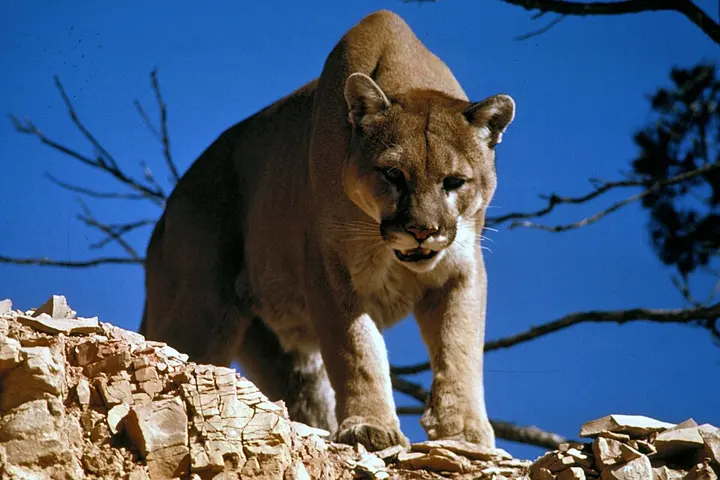
The cougar, also called puma, mountain lion, catamount, and panther, is a large feline native to the Americas. It inhabits North, Central and South America, making it the most widely distributed wild, terrestrial mammal in the Western Hemisphere, and one of the most widespread in the world. Its range spans Yukon, British Columbia and Alberta in Canada, the Rocky Mountains and areas in the western United States.
Further south, its range extends through Mexico to the Amazon rainforest and the southern Andes Mountains in Patagonia. It is an adaptable generalist species, occurring in most American habitat types. It prefers habitats with dense underbrush and rocky areas for stalking but also lives in open areas. The cougar is largely solitary. Its activity pattern varies from diurnality and cathemerality to crepuscularity and nocturnality between protected and non-protected areas, and is apparently correlated with the presence of other predators, prey species, livestock and humans. It is an ambush predator that pursues a wide variety of prey. Ungulates, particularly deer, are its primary prey, but it also hunts rodents. It is territorial and lives at low population densities.
Appearance
The head of the cougar is round, and the ears are erect. Its powerful forequarters, neck, and jaw serve to grasp and hold large prey. It has four retractile claws on its hind paws and five on its forepaws, of which one is a dewclaw. The larger front feet and claws are adaptations for clutching prey. The cougar is slender and agile. It is the fourth largest cat species; adults stand about 60 to 90 cm (24 to 35 in) tall at the shoulders.
Behaviour
The cougar is a keystone species in Western Hemisphere ecosystems as it links numerous species at many trophic levels, interacting with 485 other species as food source and prey, carcass remains left behind, and competitive effects on other predators in shared habitat.
Habitat
The cougar has the most extensive range of any wild land animal in the Americas, spanning 110 degrees of latitude from the Yukon in Canada to the southern Andes in Chile. It is recolonizing its former range in both the midwestern US and Canada, and isolated populations have been documented east of the contemporary ranges.
Life cycle
Females reach sexual maturity at the age of 18 months to three years and are in estrus for about eight days of a 23-day cycle; the gestation period is approximately 91 days. Both adult males and females may mate with multiple partners, and a female's litter can have multiple paternities. Copulation is brief but frequent. Chronic stress can result in low reproductive rates in captivity as well as in the field. Gestation is 82–103 days long.
Where the Cougar lives
Recorded in United States of America, Chile, Colombia, Brazil, Mexico, Argentina, Ecuador, Costa Rica and Canada (North America and South America).
Most records fall in California, Nebraska, Aisén del General Carlos Ibáñez del Campo, Magallanes y Antártica Chilena, Misiones and New Mexico.
See the Cougar’s range on the globe
Conservation status
Least concern (LC). Not at risk: it is doing well in the wild. Categories are the IUCN Red List as republished by GBIF.
Sources
The range is a density of 23,607 georeferenced GBIF records, shown on the continents where it is mainly recorded, not an expert-drawn map. Description from Wikipedia.