Animals / Mammal
Common wombat
Vombatus ursinus · Vombatidae
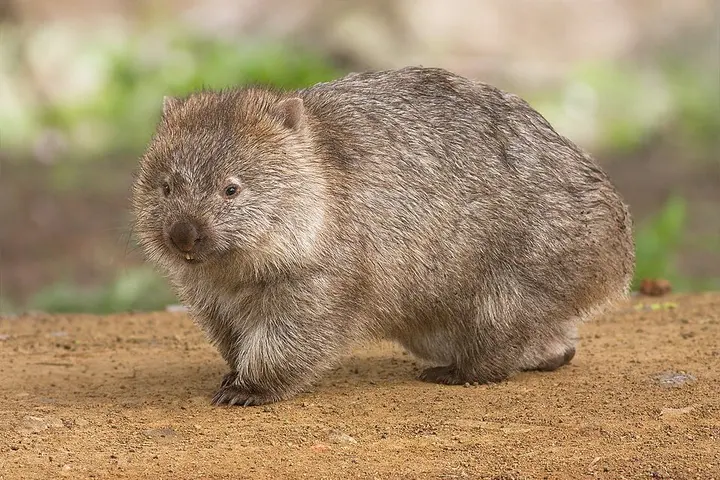
The common wombat, also known as the bare-nosed wombat, is a marsupial, one of three extant species of wombats and the sole extant member of the genus Vombatus. It has three subspecies: Vombatus ursinus hirsutus, found on the Australian mainland; Vombatus ursinus tasmaniensis, found in Tasmania; and Vombatus ursinus ursinus, found on Flinders Island and Maria Island in the Bass Strait.
Being a marsupial, its joeys inhabit a pouch on the mother for around five months after birth.
Appearance
Common wombats are sturdy and built close to the ground. They have small ears and eyes, and a large bald nose. Their fur is thick and coarse and its colour varies from light brown to grey and black. The Flinders Island wombat is the smallest of the three subspecies at around 75 cm (30 in) in length, while the Tasmanian wombat averages 85 cm (33 in) and a weight of 20 kg (44 lb).
Behaviour
Common wombats have been described as ecological engineers, as their burrow building results in soil turnover and aeration, which assists plant growth, and provides habitat for a range of invertebrate and vertebrate species. Common wombats are a solitary, territorial species, with each wombat having an established range in which it lives and feeds.
Diet
Common wombats are herbivorous, subsisting on grass, snow tussocks, and other plant materials. Foraging is usually done during the night. They are the only marsupial in the world whose teeth constantly grow. Due to the underlying enamel structure of the teeth, the continuously growing teeth maintain a self-sharpening ridge which allows easier grazing of the diet consisting of mainly native grasses. Captive wombats are also fed a range of vegetables.
Habitat
Scientists estimate that around 1.3 million common wombats remain in the wild, more than two thirds of are restricted to islands including Tasmania though numbers are declining nationally. Common wombats are widespread in the cooler and better-watered parts of southern and eastern Australia, including Tasmania and Victoria, and in mountain districts as far north as southern Queensland. In Tasmania, their preference is heathland, coastal scrub, and open forest.
Life cycle
The common wombat breeds mainly in winter. It can breed every two years and produce a single joey. Wombats appear to mate side-ways The gestation period is about 20–30 days, and the young remain in the pouch for five months. When leaving the pouch, they weigh between 3.5 and 6.5 kg (7.7 and 14.3 lb). The joey is weaned around 12 to 15 months of age, and is usually independent at 18 months of age.
Where the Common wombat lives
Recorded in Ashmore and Cartier Is. (Oceania).
Most records fall in New South Wales, Victoria, Tasmania, Australian Capital Territory and South Australia.
See the Common wombat’s range on the globe
Conservation status
Least concern (LC). Not at risk: it is doing well in the wild. Categories are the IUCN Red List as republished by GBIF.
Sources
The range is a density of 120,269 georeferenced GBIF records, shown on the continents where it is mainly recorded, not an expert-drawn map. Description from Wikipedia.