Animals / Mammal
Common warthog
Phacochoerus africanus · Suidae
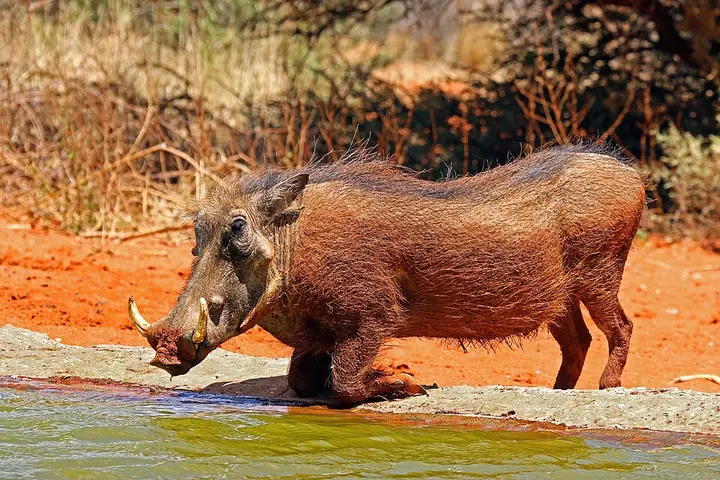
The common warthog is a wild member of the pig family (Suidae) found in grassland, savanna, and woodland in sub-Saharan Africa. In the past, it was commonly treated as a subspecies of P. aethiopicus, but today that scientific name is restricted to the desert warthog of northern Kenya, Somalia, and eastern Ethiopia.
Appearance
The common warthog is a medium-sized species, with a head-and-body length ranging from 0.9 to 1.5 m (2 ft 11 in to 4 ft 11 in), and shoulder height from 63.5 to 85 cm (25.0 to 33.5 in). Females, at 45 to 75 kg (99 to 165 lb), are smaller and lighter than males, at 60 to 150 kg (130 to 330 lb). A warthog is identifiable by the two pairs of tusks protruding from the mouth and curving upwards.
Behaviour
The common warthog is the only pig species that has adapted to grazing and savanna habitats. Its diet is omnivorous, composed of grasses, roots, berries and other fruits, bark, fungi, dung, insects, eggs and carrion. The diet is seasonably variable, depending on availability of different food items. During the wet seasons, warthogs graze on short perennial grasses. During the dry seasons, they subsist on bulbs, rhizomes, and nutritious roots.
Where the Common warthog lives
Recorded in South Africa, Benin, Kenya, Tanzania, Namibia, Zambia, Uganda, Botswana, Senegal and Zimbabwe (Africa).
Most records fall in Mpumalanga, KwaZulu-Natal, Rift Valley, Limpopo, Atakora and Alibori.
See the Common warthog’s range on the globe
Conservation status
Least concern (LC). Not at risk: it is doing well in the wild. Categories are the IUCN Red List as republished by GBIF.
Sources
The range is a density of 20,767 georeferenced GBIF records, shown on the continents where it is mainly recorded, not an expert-drawn map. Description from Wikipedia.