Animals / Amphibian
Common toad
Bufo bufo · Bufonidae
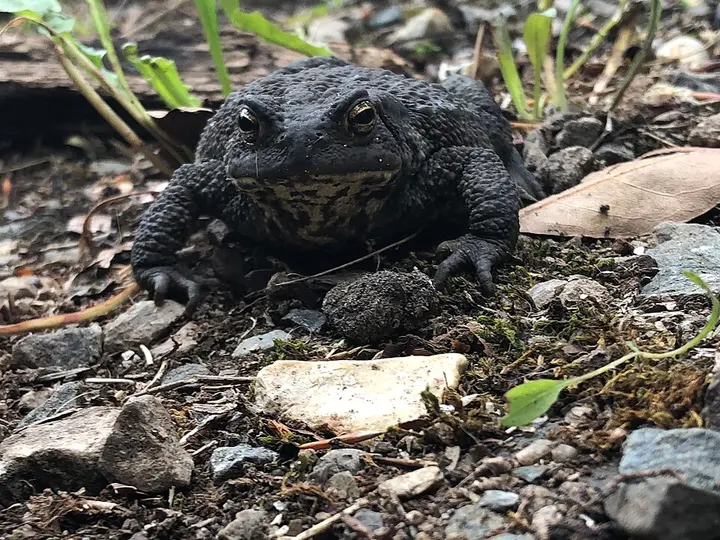
The common toad, also known as European toad or simply the toad in Anglophone parts of Europe, is a toad found throughout most of Europe, western North Asia and a small part of Northwest Africa. It belongs to a group of closely related species descended from a common ancestral line of toads and forming a species complex. The toad is an inconspicuous animal, usually lying hidden during the day.
It becomes active at dusk, hunting the invertebrates on which it feeds at night. It moves with a slow, ungainly walk or by jumping short distances, and has greyish-brown skin covered with wart-like lumps. Although toads are usually solitary animals, large numbers of them converge on certain breeding ponds during the breeding season, where the males compete to mate with the females. The females lay their eggs in gelatinous strings in the water, which later hatch into tadpoles. After several months of growth and development, the tadpoles sprout limbs and undergo metamorphosis to become tiny toads. The juveniles then leave the water and remain largely terrestrial for the rest of their lives.
Appearance
The common toad can grow to around 15 cm (6 in) in length. Females are usually stockier than males, and southern specimens tend to be larger than northern ones. Its head is broad, with a wide mouth below the terminal snout, which has two small nostrils. There are no teeth. The bulbous, protruding eyes have yellow or copper-coloured irises and horizontal, slit-shaped pupils. Just behind the eyes are two bulging regions: the paratoid glands, which are positioned obliquely.
Habitat
After the common frog (Rana temporaria), the edible frog (Pelophylax esculentus) and the smooth newt (Lissotriton vulgaris), the common toad is the fourth most common amphibian in Europe. It is found throughout the continent except in Iceland, the cold northern parts of Scandinavia, and a number of Mediterranean islands. These include Malta, Crete, Corsica, Sardinia and the Balearic Islands. It has been introduced to a number of places in Ireland, and appears to be thriving.
Life cycle
The common toad emerges from hibernation in spring, migrating en masse to the breeding sites. They converge on certain favoured ponds while avoiding other seemingly suitable stretches of water. Adults use the same location year after year, and over 80% of males marked as juveniles have been found to return to the pond where they were spawned.
Where the Common toad lives
Recorded in Switzerland, Netherlands, France, United Kingdom, Germany, Austria, Sweden, Denmark and Russia (Europe).
Most records fall in Gelderland, Zuid-Holland, Nordrhein-Westfalen, Vaud, Bern and Noord-Brabant.
See the Common toad’s range on the globe
Conservation status
Least concern (LC). Not at risk: it is doing well in the wild. Categories are the IUCN Red List as republished by GBIF.
Sources
The range is a density of 758,775 georeferenced GBIF records, shown on the continents where it is mainly recorded, not an expert-drawn map. Description from Wikipedia.