Animals / Bird
Common starling
Sturnus vulgaris · Sturnidae
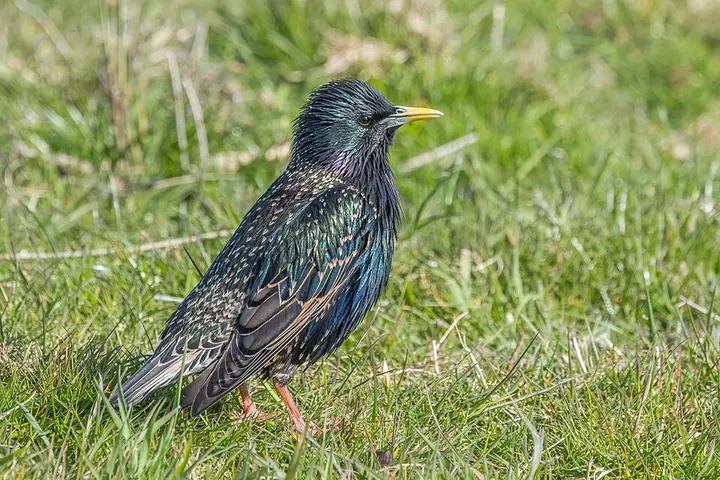
The common starling, also known simply as the starling in Great Britain and Ireland, and as the European starling in North America, is a medium-sized passerine bird in the starling family, Sturnidae. It is about 20 cm (8 in) long and has glossy black plumage with a metallic sheen, which is speckled with white at some times of the year. The legs are pink and the bill is black in winter and yellow in summer; young birds have browner plumage than the adults.
Its gift for mimicry has been noted in literature including the Mabinogion and the works of Pliny the Elder and William Shakespeare. The common starling has about 12 subspecies breeding in open habitats across its native range in temperate Europe and across the Palearctic to western Mongolia, and it has been introduced as an invasive species to Australia, New Zealand, Canada, the United States, Mexico, Argentina, South Africa and Fiji. This bird is resident in western and southern Europe and southwestern Asia, while northeastern populations migrate south and west in the winter within the breeding range and also further south to Iberia and North Africa. The common starling builds an untidy nest in a natural or artificial cavity in which four or five glossy, pale blue eggs are laid.
Appearance
The common starling is 19–23 cm (7.5–9.1 in) long, with a wingspan of 31–44 cm (12–17 in) and a weight of 58–101 g (2.0–3.6 oz). Among standard measurements, the wing chord is 11.8 to 13.8 cm (4.6 to 5.4 in), the tail is 5.8 to 6.8 cm (2.3 to 2.7 in), the culmen is 2.5 to 3.2 cm (0.98 to 1.26 in) and the tarsus is 2.7 to 3.2 cm (1.1 to 1.3 in). The plumage is iridescent black, glossed purple or green, and spangled with white, especially in winter.
Behaviour
The common starling is a highly gregarious species, especially in autumn and winter. Although flock size is highly variable, huge, noisy flocks (murmurations) may form near roosts. These dense concentrations of birds are thought to be a defence against attacks by birds of prey such as peregrine falcons or Eurasian sparrowhawks. Flocks form a tight sphere-like formation in flight, frequently expanding and contracting and changing shape, seemingly without any sort of leader.
Diet
The common starling is largely insectivorous and feeds on both pest and other arthropods. The food range includes spiders, crane flies, moths, mayflies, dragonflies, damsel flies, grasshoppers, earwigs, lacewings, caddisflies, flies, beetles, sawflies, bees, wasps and ants. Prey are consumed in both adult and larvae stages of development, and common starlings will also feed on earthworms, snails, small amphibians and lizards.
Habitat
The global population of common starlings was estimated to be 310 million individuals in 2004, occupying a total area of 8,870,000 km2 (3,420,000 sq mi).
Where the Common starling lives
Recorded in United Kingdom, Sweden, France, Netherlands, Germany, Denmark and Norway (North America, Europe and Oceania).
Introduced, not native, in United States of America, Canada and Ashmore and Cartier Is..
Most records fall in California, New York, Ontario, Québec, Pennsylvania and Texas.
See the Common starling’s range on the globe
Conservation status
Least concern (LC). Not at risk: it is doing well in the wild. Categories are the IUCN Red List as republished by GBIF.
Sources
The range is a density of 28,339,549 georeferenced GBIF records, shown on the continents where it is mainly recorded, not an expert-drawn map. Description from Wikipedia.