Animals / Starfish
Common starfish
Asterias rubens · Asteriidae
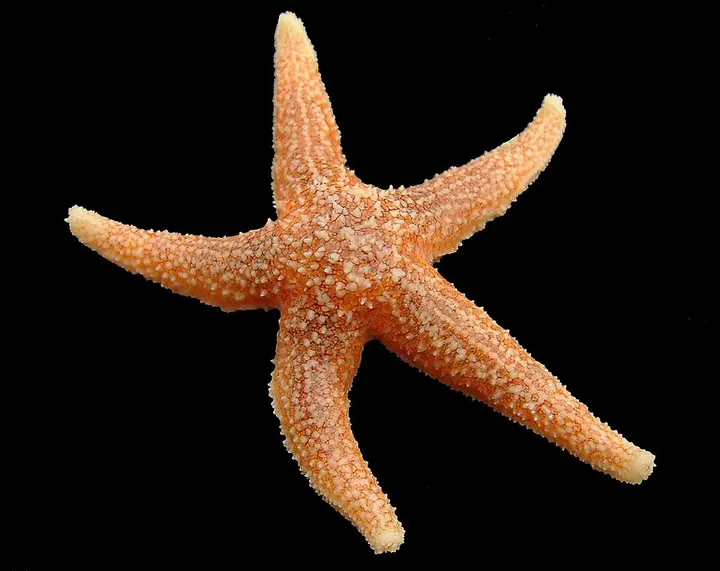
The common starfish, common sea star or sugar starfish is the most common and familiar starfish in the north-east Atlantic. Belonging to the family Asteriidae, it has five arms and usually grows to between 10–30 cm across, although larger specimens are known. The common starfish is usually orange or brownish in color, and sometimes violet; specimens found in deeper waters are pale.
The common starfish is found on rocky and gravelly substrates where it feeds on mollusks and other benthic invertebrates.
Appearance
The common starfish normally has five arms, broad at their base and gradually tapering to a point at their tips, which are often turned up slightly. There is a line of short white spines running along the centre of the aboral (upper) surface of the arms with low, soft mounds called papulae on either side. The oral (lower) surfaces of the arms have rows of small tube feet, used in locomotion and feeding.
Behaviour
The common starfish feeds on a variety of benthic organisms. These include bivalve molluscs, polychaete worms, barnacles, gastropod molluscs, other echinoderms and carrion. When feeding on a mollusc such as a mussel, it attaches its tube feet to each shell valve and exerts force to separate them slightly. Even a gap of just 1 mm (0.04 in) is sufficient for the starfish to insert a fold of its stomach, secrete enzymes and start digesting the mollusc body.
Habitat
The common starfish is native to the northeastern Atlantic Ocean and its range extends from Norway and Sweden, through the North Sea, round the coasts of Britain, France, Spain and Portugal and southwards along the coasts of Africa to Senegal. It is largely absent from the Mediterranean Sea. It is also known from the western Atlantic where it occurs between Labrador and Florida and the Gulf of Mexico. It is capable of surviving in brackish water.
Where the Common starfish lives
Recorded in United Kingdom, Netherlands, Canada, Ireland, Norway, Sweden, France, United States of America and Germany (Europe and North America).
Most records fall in Highland, Argyll and Bute, Zuid-Holland, Noord-Holland, Zeeland and Norfolk.
See the Common starfish’s range on the globe
Conservation status
Not evaluated (NE). Scientists haven’t checked yet how at risk it is, so this doesn’t mean it is safe or in danger. Categories are the IUCN Red List as republished by GBIF.
Sources
The range is a density of 69,948 georeferenced GBIF records, shown on the continents where it is mainly recorded, not an expert-drawn map. Description from Wikipedia.