Animals / Reptile
Common snapping turtle
Chelydra serpentina · Chelydridae
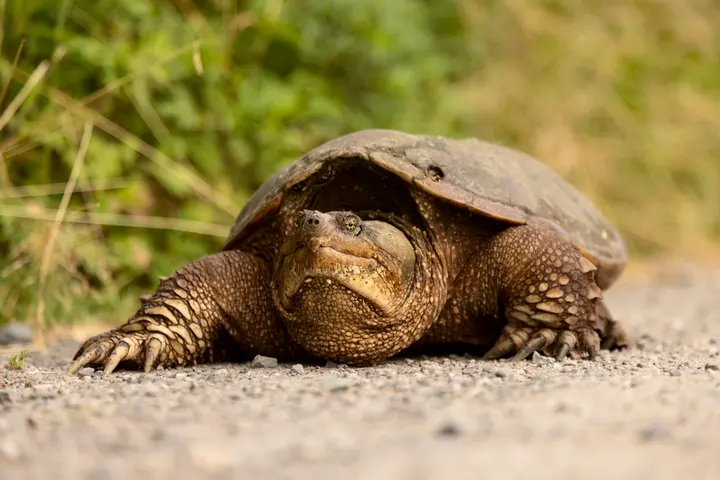
The common snapping turtle is a species of large, freshwater turtles in the family Chelydridae. Its natural range extends from southeastern Canada, southwest to the edge of the Rocky Mountains, as far east as Nova Scotia, and Florida. The present-day C. serpentina population in the Middle Rio Grande suggests that the common snapping turtle has been present in this drainage since at least the 17th century and is likely native.
The three species of Chelydra and the larger alligator snapping turtles (genus Macrochelys) are the only extant chelydrids, a family now restricted to the Americas. The common snapping turtle, as its name implies, is the most widespread. The common snapping turtle is noted for its combative disposition when out of the water, with its powerful, beak-like jaws, and highly mobile head and neck (hence the specific epithet serpentina, meaning "snake-like"). In water, it is likely to flee and hide underwater in sediment. The common snapping turtle has a life-history strategy characterized by high and variable mortality of embryos and hatchlings, delayed sexual maturity, extended adult longevity, and iteroparity (repeated reproductive events) with low reproductive success per reproductive event.
Appearance
C. serpentina has a rugged, muscular build with a ridged carapace (upper shell) that varies in color from tan to brown and black, although ridges tend to be more pronounced in younger individuals. The straight-line carapace length in adulthood may be nearly 50 cm (20 in), though lengths of 25–47 cm (9.8–18.5 in) are more common. C. serpentina usually weighs 4.5–16 kg (9.9–35.3 lb).
Behaviour
When common snapping turtles encounter a species unfamiliar to them, such as humans, in rare instances, they become curious and survey the situation and even more rarely may bump their noses on a leg of the person standing in the water. Although common snapping turtles have fierce dispositions, when they are encountered in the water or a swimmer approaches, they usually slip quietly away from any disturbance or may seek shelter under mud or grass nearby.
Diet
Common snapping turtles are omnivorous. Important aquatic scavengers, they are also active hunters that use ambush tactics to prey on anything they can swallow, including many invertebrates, fish, frogs, other amphibians, reptiles (including snakes and smaller turtles), unwary birds, and small mammals. There has been no documented difference between the diets of males and females.
Life cycle
These turtles travel extensively over land to reach new habitats or to lay eggs. Pollution, habitat destruction, food scarcity, overcrowding, and other factors drive them to move; finding them traveling far from the nearest water source is common. Experimental data support the idea that common snapping turtles can sense the Earth's magnetic field, which could also be used for such movements (together with a variety of other possible orientation cues).
Where the Common snapping turtle lives
Recorded in United States of America and Canada (North America).
Most records fall in Ontario, Virginia, New York, Texas, North Carolina and Ohio.
See the Common snapping turtle’s range on the globe
Conservation status
Least concern (LC). Not at risk: it is doing well in the wild. Categories are the IUCN Red List as republished by GBIF.
Sources
The range is a density of 92,815 georeferenced GBIF records, shown on the continents where it is mainly recorded, not an expert-drawn map. Description from Wikipedia.