Animals / Bird
Common raven
Corvus corax · Corvidae
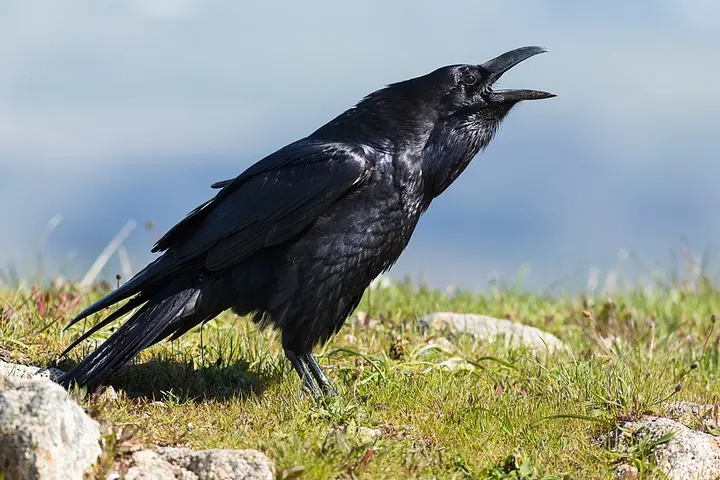
The common raven or northern raven is a large all-black passerine bird. It is the most widely distributed of all corvids, found across the Northern Hemisphere. There are 11 accepted subspecies with little variation in appearance, although recent research has demonstrated significant genetic differences among populations from various regions.
It is one of the two largest corvids, alongside the thick-billed raven, and is the heaviest passerine bird; at maturity, the common raven averages 63 centimetres (25 inches) in length and 1.47 kilograms (3.2 pounds) in weight, up to 2 kg (4.4 lb) in the heaviest individuals. Although their typical lifespan is considerably shorter, common ravens can live more than 23 years in the wild. Young birds may travel in flocks but later mate for life, with each mated pair defending a territory. Common ravens have coexisted with humans for thousands of years and in some areas have been so numerous that people have regarded them as pests.
Appearance
A mature common raven ranges between 54 and 71 cm (21 and 28 in) and has a wingspan of 116 to 153 cm (46 to 60 in). Recorded weights range from 0.69 to 2.250 kg (1.52 to 4.96 lb), thus making the common raven one of the heaviest passerines. Birds from colder regions such as the Himalayas and Greenland are generally larger with slightly larger bills, while those from warmer regions are smaller with proportionally smaller bills.
Behaviour
Common ravens usually travel in mated pairs, although young birds may form flocks. Relationships between common ravens are often quarrelsome, yet they demonstrate considerable devotion to their families.
Diet
Common ravens are omnivorous and highly opportunistic: their diet may vary widely with location, season and serendipity. For example, those foraging on tundra on the Arctic North Slope of Alaska obtained about half their energy needs from predation, mainly of microtine rodents, and half by scavenging, mainly of caribou and ptarmigan carcasses. In some places they are mainly scavengers, feeding on carrion as well as the associated maggots and carrion beetles.
Habitat
The common raven can thrive in varied climates; it has the largest range of any member of the genus, and one of the largest of any passerine. They range throughout the Holarctic from Arctic and temperate habitats in North America and Eurasia to the deserts of North Africa, and to islands in the Pacific Ocean. In the British Isles, they are more common in Scotland, Wales, western England and Ireland, having been eradicated from other areas by gamekeeping interests.
Life cycle
Juveniles begin to court at a very early age, but may not bond for another two or three years. Aerial acrobatics and ability to provide food are key behaviours of courting. Once paired, they tend to nest together for life, usually in the same location. Instances of non-monogamy have been observed in common ravens, by males visiting a female's nest when her mate is away.
Where the Common raven lives
Recorded in United States of America, Canada, Sweden, Denmark, Spain, Norway and United Kingdom (North America and Europe).
Most records fall in California, Québec, Arizona, British Columbia, Ontario and Washington.
See the Common raven’s range on the globe
Conservation status
Least concern (LC). Not at risk: it is doing well in the wild. Categories are the IUCN Red List as republished by GBIF.
Sources
The range is a density of 12,302,130 georeferenced GBIF records, shown on the continents where it is mainly recorded, not an expert-drawn map. Description from Wikipedia.