Animals / Bird
Common pheasant
Phasianus colchicus · Phasianidae
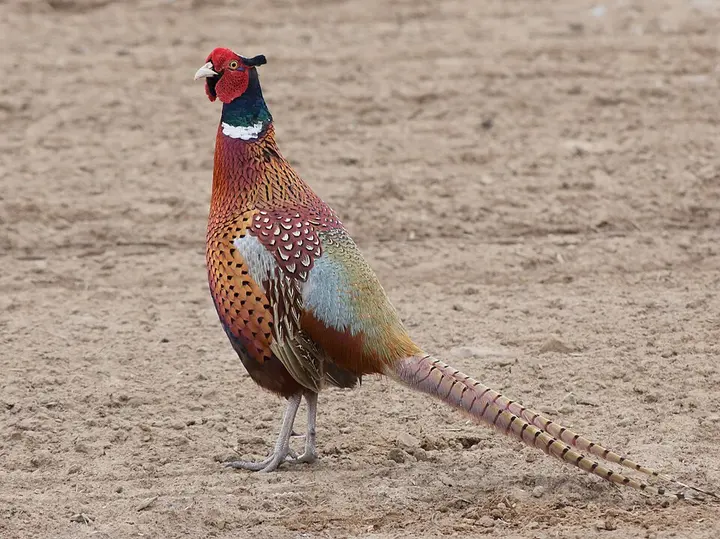
The common pheasant, ring-necked pheasant, or blue-headed pheasant, is a bird in the pheasant family (Phasianidae). The genus name comes from Latin phasianus 'pheasant'. The species name colchicus is Latin for 'of Colchis', a country on the Black Sea where pheasants became known to Europeans.
Although Phasianus was previously thought to be closely related to the genus Gallus, the genus of junglefowl and domesticated chickens, recent studies show that they are in different subfamilies, having diverged over 20 million years ago. It is native to Asia, where it is widespread, and also to the extreme southeast of Europe in the northern foothills of the Caucasus Mountains. It has been widely introduced elsewhere as a game bird. In parts of its range, mainly in places where none of its relatives occurs such as in Europe, where it is naturalised, it is simply known as the pheasant. Ring-necked pheasant is both the collective name for a number of subspecies and their intergrades that have white neck rings and the name used for the species as a whole in North America.
Appearance
There are many colour forms of the male common pheasant, ranging in colour from nearly white to almost black in some melanistic examples. These are due to captive breeding and hybridisation between subspecies and with the green pheasant, reinforced by continual releases of stock from varying sources to the wild.
Behaviour
These birds are found in woodland, farmland, scrub, and wetlands. In their natural habitat, common pheasants live in grassland near water with small copses of trees, and are tolerant of both dry and humid soils. Extensively cleared farmland, however, is marginal habitat that cannot maintain self-sustaining populations for long. Common pheasants are gregarious birds and outside the breeding season form loose flocks.
Habitat
Common pheasants are native to Asia and parts of Europe, their original range extending from the eastern Black Sea and the Caspian Sea to Manchuria, Siberia, Korea, Mainland China, and Taiwan. Southern Caucasian pheasants (P. c. colchicus) were common in Greece during the classical period and it is a widespread myth that the Greeks took pheasants to the Balkans when they colonised Colchis in the Caucasus.
Where the Common pheasant lives
Introduced, not native, in United States of America, United Kingdom, Netherlands, Sweden, Belgium, France, Denmark, Canada, Germany and Finland.
Most records fall in Minnesota, Zuid-Holland, Antwerp, Nova Scotia, East Flanders and Noord-Holland.
See the Common pheasant’s range on the globe
Conservation status
Least concern (LC). Not at risk: it is doing well in the wild. Categories are the IUCN Red List as republished by GBIF.
Sources
The range is a density of 3,448,770 georeferenced GBIF records, shown on the continents where it is mainly recorded, not an expert-drawn map. Description from Wikipedia.