Animals / Bird
Common ostrich
Struthio camelus · Struthionidae
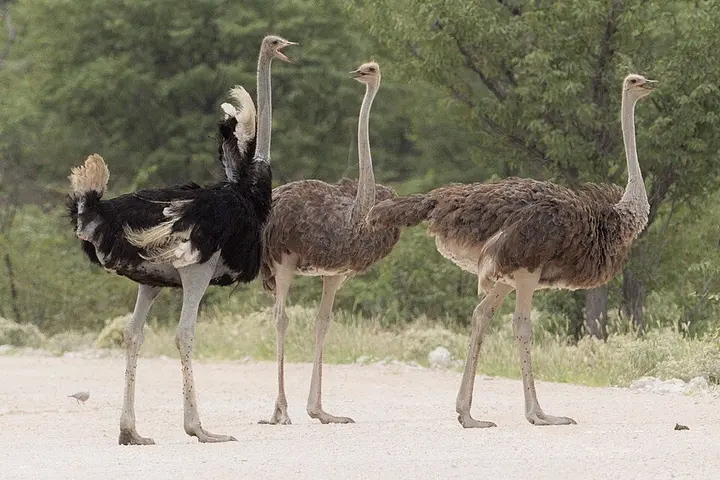
The common ostrich, or simply ostrich, is a species of flightless bird native to certain areas of Africa and is the largest living species of bird. The common ostrich is one of two extant species of ostriches, the only living members of the genus Struthio in the ratite group of birds. The other is the Somali ostrich, which has been recognised as a distinct species by BirdLife International since 2014, having been previously considered a distinctive subspecies of ostrich.
The common ostrich belongs to the order Struthioniformes. Struthioniformes previously contained all the ratites, such as the kiwis, emus, rheas, and cassowaries. However, a recent genetic analysis has found that the group is not monophyletic, as it is paraphyletic with respect to the tinamous, so the ostriches are now classified as the only members of the order. Phylogenetic studies have shown that it is the sister group to all other members of Palaeognathae, and that the flighted tinamous are the sister group to the extinct moa. It is distinctive in its appearance, with a long neck and legs, and can run for a long time at a speed of 55 km/h (34 mph) with short bursts up to about 70 km/h (43 mph), the fastest land speed of any bipedal animal.
Appearance
The common ostrich is the tallest and heaviest living bird. Males stand 2.1 to 2.75 m (6 ft 11 in to 9 ft 0 in) tall and weigh 100 to 130 kg (220 to 290 lb), whereas females are about 1.75 to 1.9 m (5 ft 9 in to 6 ft 3 in) tall and weigh 90 to 120 kg (200 to 260 lb). While exceptional male ostriches (in the nominate subspecies) can weigh up to 156.8 kg (346 lb), some specimens in South Africa can only weigh between 59.5 to 81.3 kg (131 to 179 lb).
Behaviour
Common ostriches normally spend the winter months in pairs or alone. Only 16 percent of common ostrich sightings were of more than two birds. During breeding season and sometimes during extreme rainless periods ostriches live in nomadic groups of five to 100 birds (led by a top hen) that often travel together with other grazing animals, such as zebras or antelopes. Ostriches are diurnal, but may be active on moonlit nights. They are most active early and late in the day.
Diet
They mainly feed on seeds, shrubs, grass, fruit, and flowers; occasionally they also eat insects such as locusts, rodents such as mice, small reptiles such as lizards, and animal remains left by carnivorous predators. Lacking teeth, they swallow pebbles that act as gastroliths to grind food in the gizzard. When eating, they will fill their gullet with food, which is in turn passed down their oesophagus in the form of a ball called a bolus.
Habitat
Common ostriches formerly occupied Africa north and south of the Sahara, East Africa, Africa south of the rainforest belt, and much of Asia Minor. Today common ostriches prefer open land and are native to the savannas and Sahel of Africa, both north and south of the equatorial forest zone. In southwest Africa they inhabit the semi-desert or true desert. Farmed common ostriches in Australia have established feral populations.
Where the Common ostrich lives
Recorded in South Africa, Kenya, Namibia, Tanzania and Botswana (Africa).
Most records fall in Western Cape, Rift Valley, Gauteng, Northern Cape, Limpopo and Mpumalanga.
See the Common ostrich’s range on the globe
Conservation status
Least concern (LC). Not at risk: it is doing well in the wild. Categories are the IUCN Red List as republished by GBIF.
Sources
The range is a density of 142,602 georeferenced GBIF records, shown on the continents where it is mainly recorded, not an expert-drawn map. Description from Wikipedia.