Animals / Mollusc
Common octopus
Octopus vulgaris · Octopodidae
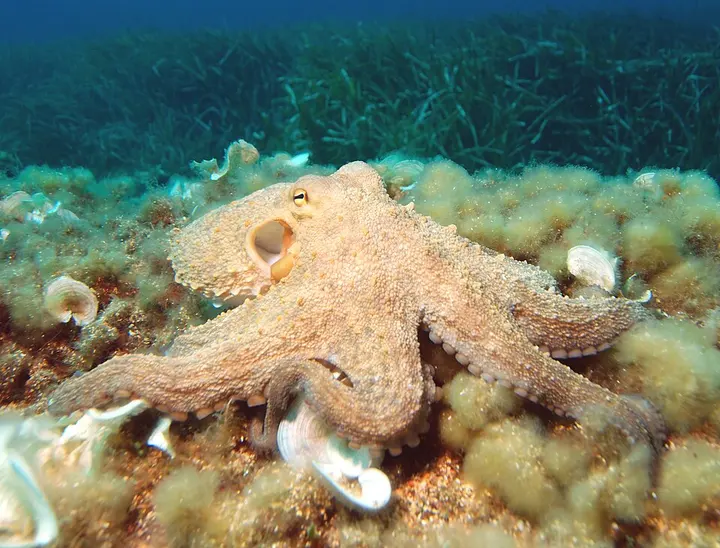
The common octopus is a mollusk belonging to the class Cephalopoda. Octopus vulgaris is one of the most studied of all the octopus species, and also one of the most intelligent. It ranges from the eastern Atlantic, extends from the Mediterranean Sea, Black sea and the southern coast of England, to the southern coast of South Africa.
It also occurs off the Azores, Canary Islands, and Cape Verde Islands. The species is also common in the Western Atlantic.
Appearance
Octopus vulgaris grows to 25 cm (10 inches) in mantle length with arms up to 1 m (3.3 feet) long. It lives for 1–2 years and may weigh up to 9 kg (20 pounds). Mating may become cannibalistic. O. vulgaris is caught by bottom trawls on a huge scale off the northwestern coast of Africa. More than 20,000 tonnes (22,000 short tons) are harvested annually. The common octopus hunts at dusk.
Life cycle
Spawning of O. vulgaris in this area extends from December to September with a unique peak in spring months.
Where the Common octopus lives
Recorded in France, Spain, Portugal, United States of America, South Africa, Greece and Italy (Europe, North America and Africa).
Most records fall in Bouches-du-Rhône, Pyrénées-Orientales, Alicante, Gerona, Var and Hérault.
See the Common octopus’s range on the globe
Conservation status
Least concern (LC). Not at risk: it is doing well in the wild. Categories are the IUCN Red List as republished by GBIF.
Sources
The range is a density of 14,643 georeferenced GBIF records, shown on the continents where it is mainly recorded, not an expert-drawn map. Description from Wikipedia.