Animals / Bird
Common myna
Acridotheres tristis · Sturnidae
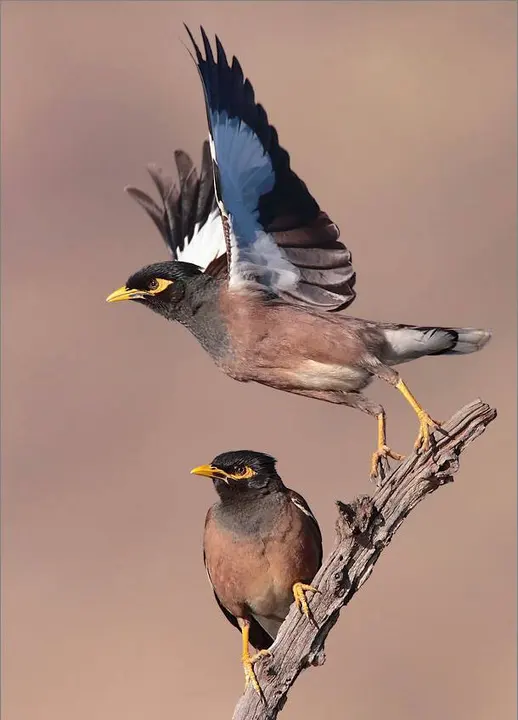
The common myna or Indian myna, sometimes spelled mynah, is a bird in the family Sturnidae, native to Asia. An omnivorous open woodland bird with a strong territorial instinct, the common myna has adapted extremely well to urban environments.
The range of the common myna is increasing at such a rapid rate that in 2000 the IUCN Species Survival Commission declared it one of the world's most invasive species and one of only three birds listed among "100 of the World's Worst Invasive Species" that pose a threat to biodiversity, agriculture and human interests. In particular, the species poses a serious threat to the ecosystems of Australia, where it was named "The Most Important Pest/Problem" in 2008.
Appearance
The common myna is readily identified by the brown body, black hooded head and the bare yellow patch behind the eye. The bill and legs are bright yellow. They have rounded wings as well, and a round square tipped tail. There is a white patch on the outer primaries and the wing lining on the underside is white, as well as having a white tail tip. The sexes are similar in colour and birds are usually seen in pairs.
Behaviour
The calls includes croaks, squawks, chirps, clicks, whistles and 'growls', and the bird often fluffs its feathers and bobs its head in singing. The common myna screeches warnings to its mate or other birds in cases of predators in proximity or when it is about to take off flying. Common mynas are popular as cage birds for their singing and "speaking" abilities. Before sleeping in communal roosts, common mynas vocalise in unison, which is known as "communal noise".
Habitat
The common myna is native to Asia, with its initial home range spanning Iran, Pakistan, India, Nepal, Bhutan, Bangladesh and Sri Lanka, Afghanistan, Uzbekistan, Tajikistan, Turkmenistan, Myanmar, Malaysia, Singapore, peninsular Thailand, Indochina, Japan (both mainland Japan and the Ryukyu Islands) and China.
Life cycle
Common mynas are believed to pair for life. They breed through much of the year depending on the location, building their nest in a hole in a tree or wall. They breed at elevations of 0–3,000 m (0–9,843 ft) in the Himalayas. The normal clutch size is 4–6 eggs. The average size of the egg is 30.8 by 21.99 millimetres (1+1⁄4 in × 3⁄4 in). The incubation period is 17 to 18 days and fledging period is 22 to 24 days. The Asian koel is sometimes brood parasitic on this species.
Where the Common myna lives
Recorded in India, Taiwan, Thailand and Sri Lanka (Asia, Oceania, Africa and North America).
Introduced, not native, in Ashmore and Cartier Is., South Africa, United States of America, New Zealand and Israel.
Most records fall in Victoria, Tamil Nadu, New South Wales, Karnataka, Kerala and Hawaii.
See the Common myna’s range on the globe
Conservation status
Least concern (LC). Not at risk: it is doing well in the wild. Categories are the IUCN Red List as republished by GBIF.
Sources
The range is a density of 3,533,709 georeferenced GBIF records, shown on the continents where it is mainly recorded, not an expert-drawn map. Description from Wikipedia.