Animals / Bird
Common loon
Gavia immer · Gaviidae
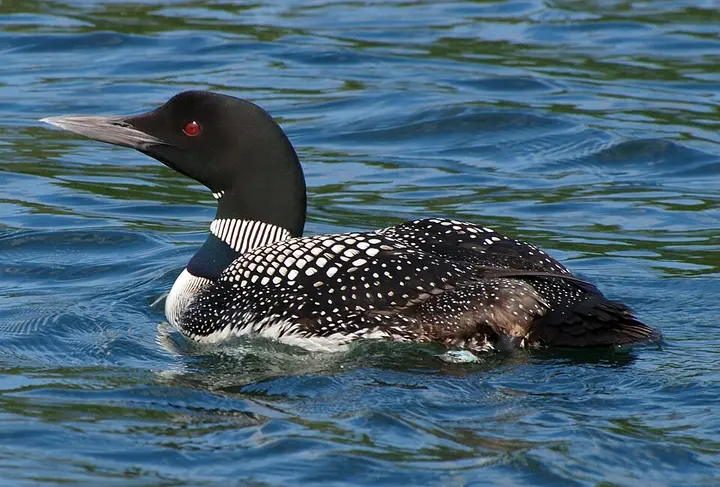
The common loon or great northern diver is a large member of the loon, or diver, family of birds. Breeding adults have a plumage that includes a broad black head and neck with a greenish, purplish, or bluish sheen, blackish or blackish-grey upperparts, and pure white underparts except some black on the undertail coverts and vent. Non-breeding adults are brownish with a dark neck and head marked with dark grey-brown.
Their upperparts are dark brownish-grey with an unclear pattern of squares on the shoulders, and the underparts, lower face, chin, and throat are whitish. The sexes look alike, though males are significantly heavier than females. During the breeding season, loons live on lakes and other waterways in Canada, the northern United States (including Alaska), and southern parts of Greenland and Iceland. Small numbers breed on Svalbard and sporadically elsewhere in Arctic Eurasia. Common loons winter on both coasts of North America as far north as Newfoundland and Alaska, and as far south as Mexico, as well as on the Atlantic coast of Europe. Common loons eat a variety of animal prey including fish, crustaceans, insect larvae, molluscs, and occasionally aquatic plant life.
Appearance
The adult common loon can range from 66 to 91 cm (26 to 36 in) in length with a 127 to 147 cm (4 ft 2 in to 4 ft 10 in) wingspan, slightly smaller than the similar yellow-billed loon. On average, it is about 81 cm (32 in) long and has a wingspan of 136 cm (54 in). Its weight can vary anywhere from 2.2 to 7.6 kg (4.9 to 16.8 lb).
Behaviour
The common loon is an expert fisher, catching its prey underwater by diving as deep as 60 m (200 ft). With its large webbed feet, the common loon is an efficient underwater pursuit predator and adroit diver. It needs a long run-up distance to gain momentum for flight take-off and is ungainly on land, sliding on its belly and pushing itself forward with its legs.
Diet
Fish account for about 80% of the diet of the common loon. It forages on fish of up to 26 cm (10 in) in length, including minnows, suckers, gizzard shad, rock bass, alewife, northern pike, whitefish, sauger, brown bullhead, pumpkinseed, burbot, walleye, bluegill, white crappie, black crappie, rainbow smelt, and killifish. The young typically eat small minnows, and sometimes insects and fragments of green vegetation.
Habitat
Common loons are mainly Nearctic, and breed from 48° N to the Arctic Circle, locally south to 40° N and north to 78° N. During their breeding season in spring and summer, most common loons live on lakes and other waterways in the northern United States and Canada, as well as in southern parts of Greenland, in Iceland, in Svalbard, in Jan Mayen, and in Bear Island in Norway; and in Alaska, to the west, and very rarely in Scotland, to the east.
Where the Common loon lives
Recorded in United States of America and Canada (North America).
Most records fall in Ontario, Québec, Maine, Massachusetts, California and British Columbia.
See the Common loon’s range on the globe
Conservation status
Least concern (LC). Not at risk: it is doing well in the wild. Categories are the IUCN Red List as republished by GBIF.
Sources
The range is a density of 3,215,107 georeferenced GBIF records, shown on the continents where it is mainly recorded, not an expert-drawn map. Description from Wikipedia.