Animals / Bird
Common grackle
Quiscalus quiscula · Icteridae
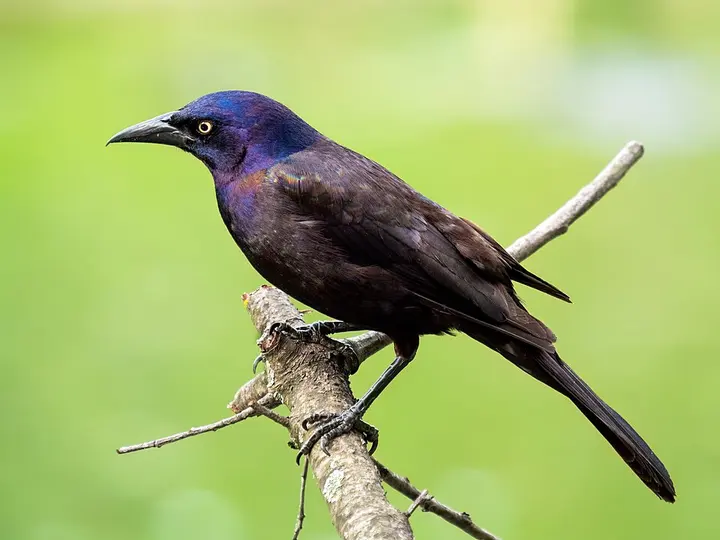
The common grackle is an icterid bird found in large numbers through much of North America. It was first described in 1758 by Carl Linnaeus and has three officially recognized subspecies. Adult common grackles have a long and dark bill, pale yellow eyes, and a long tail.
Adults often have a bluish iridescent appearance on their head, this feature being more pronounced on males. Common grackles can be found widely across North America east of the Rocky Mountains and are highly adaptable to their environment.
Appearance
Adult common grackles measure from 28 to 34 cm (11 to 13 in) in length, span 36–46 cm (14–18 in) across the wings, and weigh 74–142 g (2.6–5.0 oz). Common grackles are less sexually dimorphic than larger grackle species, but the differences between the sexes can still be noticeable. The male, which averages 122 g (4.3 oz), is larger than the female, at an average of 94 g (3.3 oz).
Behaviour
The common grackle forages on the ground, in shallow water, or in shrubs; it may steal food from other birds. It is omnivorous, eating insects, minnows, frogs, eggs, berries, seeds, grain, and even small birds and rodents. Grackles at outdoor eating areas often wait eagerly until someone drops some food. They rush forward and try to grab it, often snatching food out of the beak of another bird.
Habitat
The breeding habitat is open and semiopen areas across North America east of the Rocky Mountains. The nest is a well-concealed cup in dense trees (particularly pine) or shrubs, usually near water; sometimes, the common grackle nests in cavities or in man-made structures. It often nests in colonies, some being quite large. Bird houses are also a suitable nesting site. Four to seven eggs are in a clutch. This bird is a permanent resident in much of its range.
Life cycle
In the breeding season, males tip their heads back and fluff up feathers to display and keep other males away. This same behavior is used as a defensive posture to attempt to intimidate predators. Male common grackles are less aggressive toward one another, and more cooperative and social, than the larger boat-tailed grackle species.
Where the Common grackle lives
Recorded in United States of America and Canada (North America).
Most records fall in Ontario, New York, Québec, Florida, Massachusetts and Pennsylvania.
See the Common grackle’s range on the globe
Conservation status
Near threatened (NT). Not at risk yet, but could be soon. Categories are the IUCN Red List as republished by GBIF.
Sources
The range is a density of 12,366,516 georeferenced GBIF records, shown on the continents where it is mainly recorded, not an expert-drawn map. Description from Wikipedia.