Animals / Mammal
Common genet
Genetta genetta · Viverridae
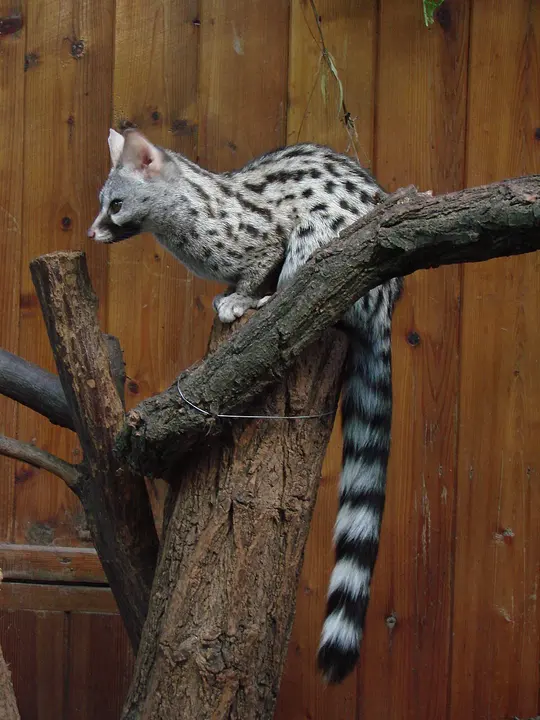
The common genet is a small viverrid indigenous to Africa that was introduced to southwestern Europe. It is widely distributed north of the Sahara, in savanna zones south of the Sahara to southern Africa and along the coast of Arabia, Yemen and Oman. It is listed as Least Concern on the IUCN Red List.
Appearance
The common genet has a slender, cat-like body, a small head with a pointed muzzle, large oval ears, large eyes and well-developed whiskers up to 7 cm (2.8 in) in length. Its legs are short, with cat-like feet and semi-retractile claws. Its fur is dense and soft, and the coat is pale grey, with numerous black markings. The back and flanks are marked with about five rows of black spots, and a long black stripe runs along the middle of the back from the shoulders to the rump.
Behaviour
The common genet is solitary. Adults are nocturnal and crepuscular, with their highest levels of activity following sunset and just prior to sunrise; juveniles may be active during the day. They rest during the day in hollow trees or among thickets, and frequently use the same resting sites.
Habitat
In North Africa, the common genet occurs along the western Mediterranean coast, and in a broad band from Senegal and Mauritania in the west throughout the savannah zone south of the Sahara to Somalia and Tanzania in the east. On the Arabian Peninsula, it was recorded in coastal regions of Saudi Arabia, Yemen and Oman. Another discontinuous population inhabits Southern Africa, from southern Angola across Zambia, Zimbabwe to Mozambique.
Life cycle
In Spain, common genets breed between January and September, with a peak in February and March and another one in the summer. Mating behaviour and development of young has been studied in captive individuals. Copulation lasts about two to three minutes, and is repeated up to five times in the same night. After a gestation period of 10 to 11 weeks, up to four young are born. Newborn common genets weigh 60 to 85 g (2.1 to 3.0 oz).
Where the Common genet lives
Introduced, not native, in France, Spain and Portugal.
Most records fall in Vendée, Gironde, Pyrénées-Atlantiques, Barcelona, Lot-et-Garonne and Deux-Sèvres.
See the Common genet’s range on the globe
Conservation status
Least concern (LC). Not at risk: it is doing well in the wild. Categories are the IUCN Red List as republished by GBIF.
Sources
The range is a density of 49,323 georeferenced GBIF records, shown on the continents where it is mainly recorded, not an expert-drawn map. Description from Wikipedia.