Animals / Amphibian
Common frog
Rana temporaria · Ranidae
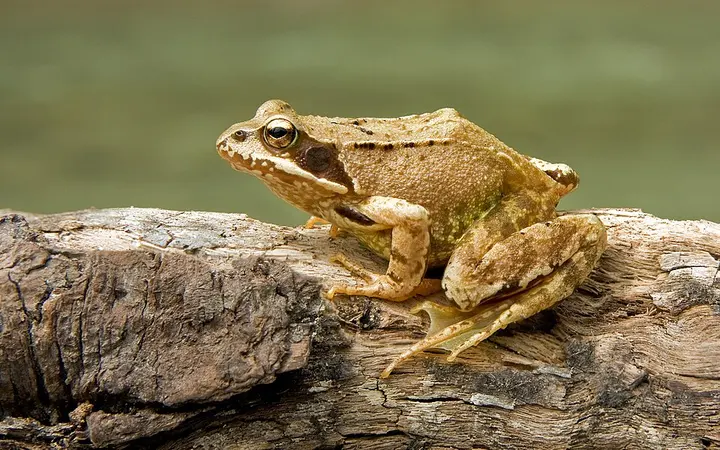
The common frog or grass frog, also known as the European common frog, European common brown frog, European grass frog, European Holarctic true frog, European pond frog, European brown frog, or simply the frog, is a semi-aquatic amphibian of the family Ranidae, found throughout much of Europe as far north as Scandinavia and as far east as the Urals, except for most of the Iberian Peninsula, southern Italy, and the southern Balkans. The farthest west it can be found is Ireland. It is also found in Asia, and eastward to Japan.
The nominative, and most common, subspecies Rana temporaria temporaria is a largely terrestrial frog native to Europe. It is distributed throughout northern Europe and can be found from Ireland to as far east as Japan. Common frogs undergo metamorphosis through three distinct life stages — aquatic larva, terrestrial juvenile, and adult. They have plump bodies with rounded snouts, webbed feet, and long hind legs adapted for swimming and hopping on land. They are often confused with the common toad (Bufo bufo), but can be easily distinguished by their longer legs, hopping movements, and moist skin; toads have shorter legs, crawl and have a dry 'warty' skin. The two species also lay their eggs differently, frogs lay their eggs in clumps, whereas toads lay theirs in long strings.
Appearance
The adult common frog has a body length of 6 to 9 centimetres (2.4 to 3.5 in). In addition, its back and flanks vary in colour from olive green to grey-brown, brown, olive brown, grey, yellowish and rufous. However, it can lighten and darken its skin to match its surroundings. Some individuals have more unusual colouration—both black and red individuals have been found in Scotland, and albino frogs have been found with yellow skin and red eyes.
Behaviour
Similar to other anuran species (Anaxyrus americanus and Rana sylvatica), Rana temporaria are able to naturally discriminate others of its kind. Post-embryonic interaction with conspecifics is not necessary to induce associative behavior for common frogs as an adult. Rather, once common frog tadpoles have reached a certain age, they gain a strong innate associative tendency.
Diet
During metamorphosis, when the tadpole's front legs have developed, the frog stops eating for a short time. Recently metamorphosed juveniles feed mainly on small arthropods such as Collembola (springtails), Acarina (mites and ticks), and small fly larvae. Rana temporaria tadpoles, however, mostly feed on algae and decomposed plants, but when their hind legs develop, they become carnivorous.
Habitat
Outside the breeding season, common frogs live a solitary life in damp wetland niches near ponds or marshes or among long riparian grass. They are normally active for much of the year, only hibernating in the coldest months. In the most northern extremities of their range they may be trapped under ice for up to nine months of the year, but recent studies have shown that in these conditions they may be relatively active at temperatures close to freezing.
Where the Common frog lives
Recorded in Switzerland, Netherlands, United Kingdom, France, Austria, Germany, Denmark, Sweden, Russia and Norway (Europe).
Most records fall in Vaud, Noord-Brabant, Zuid-Holland, Bern, Nordrhein-Westfalen and Gelderland.
See the Common frog’s range on the globe
Conservation status
Least concern (LC). Not at risk: it is doing well in the wild. Categories are the IUCN Red List as republished by GBIF.
Sources
The range is a density of 795,512 georeferenced GBIF records, shown on the continents where it is mainly recorded, not an expert-drawn map. Description from Wikipedia.