Animals / Mammal
Common eland
Tragelaphus oryx · Bovidae
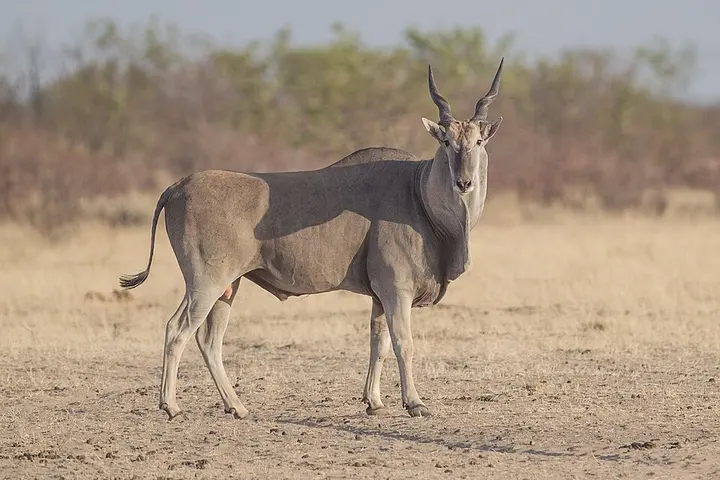
The common eland, also known as the southern eland or eland antelope, is a large savannah and plains antelope found in East and Southern Africa. An adult male is around 1.6 m (5.2 ft) tall at the shoulder and can weigh up to 942 kg (2,077 lb) with a typical range of 500–600 kg (1,100–1,300 lb). Females are around 1.4 m (4.6 ft) tall and weigh 340–445 kg (750–981 lb).
It was scientifically described by Peter Simon Pallas in 1766. Mainly a herbivore, its diet is primarily grasses and leaves. Common elands form herds of up to 500 animals, but are not territorial. The common eland prefers habitats with a wide variety of flowering plants such as savannah, woodlands, and open and montane grasslands; it avoids dense forests. It uses loud barks, visual and postural movements, and the flehmen response to communicate and warn others of danger. The common eland is used by humans for leather and meat, and has been domesticated in southern Africa. Eland milk contains more butterfat than cow's milk, and can be stored for up to eight months.
Appearance
Common elands are spiral-horned antelopes. They are sexually dimorphic, with females being smaller than the males. Females weigh 300–600 kg (660–1,320 lb), measure 200–280 cm (79–110 in) from the snout to the base of the tail and stand 125–153 cm (49–60 in) at the shoulder. Bulls weigh 400–942 kg (882–2,077 lb), are 240–345 cm (94–136 in) from the snout to the base of the tail and stand 150–183 cm (59–72 in) at the shoulder. The tail is 50–90 cm (20–35 in) long.
Behaviour
Common elands are nomadic and crepuscular. They eat in the morning and evening, rest in shade when hot, and remain in sunlight when cold. They are commonly found in herds numbering up to 500, with individual members remaining in the herd from several hours to several months. Juveniles and mothers tend to form larger herds, while males may separate into smaller groups or wander individually. During estrus, mainly in the rainy season, groups tend to form more regularly.
Diet
Common elands are herbivores that browse during drier winter, but have also adapted to grazing during the rainy season when grasses are more common and nutritious. They require a high-protein diet of succulent leaves from flowering plants, but will consume lower-quality plant material if available, including forbs, trees, shrubs, grasses, seeds, and tubers. Grasses that elands eat include Setaria and Themeda and fruits from Securinega and Strychnos.
Habitat
Common elands live on the open plains of Southern Africa and along the foothills of the great southern African plateau. The species extends north into Ethiopia and most arid zones of South Sudan, west into eastern Angola and Namibia, and south to South Africa. However, a low density of elands exists in Africa due to poaching and human settlement.
Where the Common eland lives
Recorded in South Africa, Kenya, Tanzania, Namibia, Uganda, Zimbabwe, Angola and Botswana (Africa).
Most records fall in Western Cape, Rift Valley, Gauteng, Eastern Cape, Limpopo and KwaZulu-Natal.
See the Common eland’s range on the globe
Conservation status
Least concern (LC). Not at risk: it is doing well in the wild. Categories are the IUCN Red List as republished by GBIF.
Sources
The range is a density of 6,979 georeferenced GBIF records, shown on the continents where it is mainly recorded, not an expert-drawn map. Description from Wikipedia.