Animals / Insect
Common eastern firefly
Photinus pyralis · Lampyridae
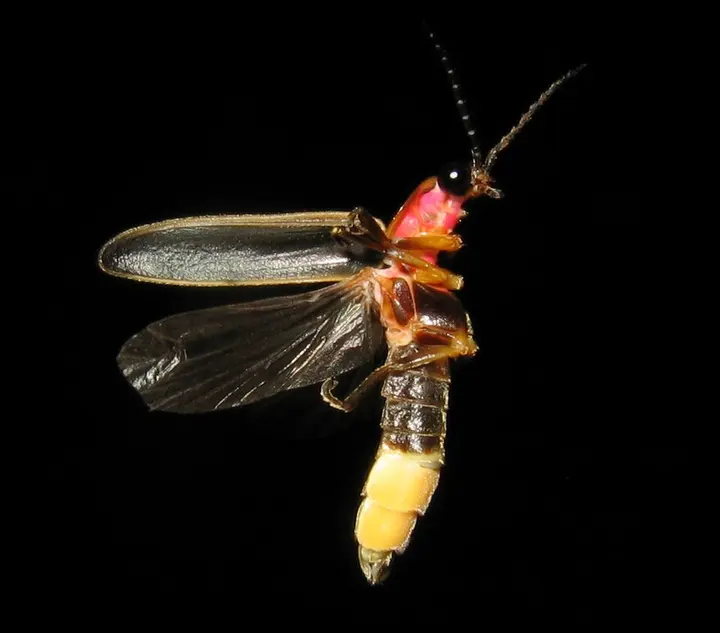
Photinus pyralis, also known by the common names the common eastern firefly or big dipper firefly, and sometimes called a "lightning bug", is a species of flying beetle. An organ on its abdomen is responsible for its light production. It is the most common species of firefly in North America and is typically found east of the Rocky Mountains.
Photinus fireflies are often confused with fireflies of the similar-sounding genus, Photuris, which are also found in North America. These fireflies are most noticeable around twilight in the spring and summer months. The common name, big dipper firefly, is due to the characteristic flight of the males, whose trajectory appears to follow a J-shape, lighting on the upswing. During flight, this J-pattern is used alongside light flashing to attract females, who rest on vegetation and signal back to males if interested. The firefly flashes are stimulated by light-activated proteins, not rhythmic impulses as originally thought.
Appearance
Common Eastern fireflies are small soft-bodied beetles that are 9–19 mm (0.4–0.7 in) long. They have flat black or brown bodies with wing coverings, or elytra, that extend the length of their entire thorax and abdomen. The elytra have a yellow border. The head shield, or pronotum, is pale yellow, with a black dot in the center, surrounded by pink or red. Both males and females of this species have light-emitting organs on the ventral side of their abdomens.
Habitat
P. pyralis is widespread across the eastern half of North America.
Life cycle
Like all beetles, the life cycle of a common Eastern firefly consists of four unique life stages starting with the egg, moving to the larval stage, followed by a pupa, before finally completing the cycle as a fully formed adult. The time it takes for fireflies to complete all four stages can vary drastically by species, especially because they inhabit such a wide range of environments that the resources available to them vary significantly.
Where the Common eastern firefly lives
Recorded in United States of America and Mexico (North America).
Most records fall in North Carolina, Pennsylvania, Ohio, Virginia, New York and Texas.
See the Common eastern firefly’s range on the globe
Conservation status
Least concern (LC). Not at risk: it is doing well in the wild. Categories are the IUCN Red List as republished by GBIF.
Sources
The range is a density of 14,006 georeferenced GBIF records, shown on the continents where it is mainly recorded, not an expert-drawn map. Description from Wikipedia.