Animals / Worm
Common earthworm
Lumbricus terrestris · Lumbricidae
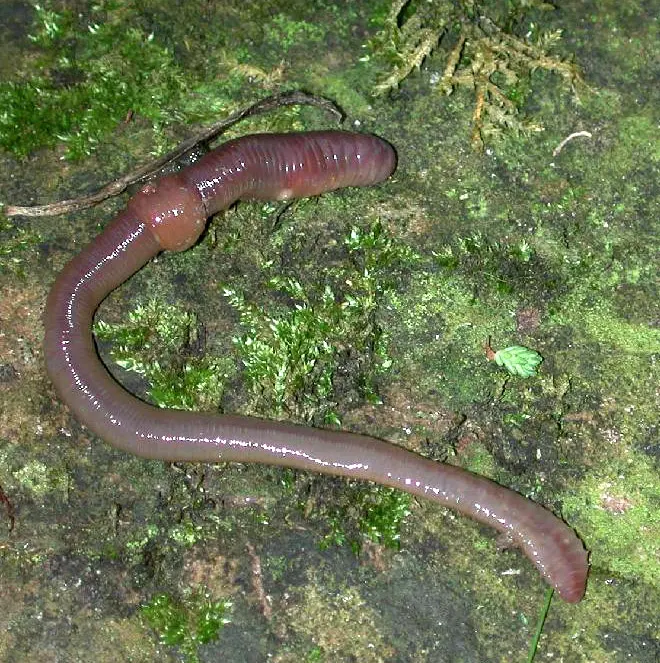
Lumbricus terrestris is a large, reddish worm species thought to be native to Western Europe, now widely distributed around the world. In some areas where it is an introduced species, some people consider it to be a significant pest for out-competing native worms.
Through much of Europe, it is the largest naturally occurring species of earthworm, typically reaching 20 to 25 cm in length when extended.
Appearance
Lumbricus terrestris is relatively large, pinkish to reddish-brown in colour, generally 110–200 millimetres (4.3–7.9 in) in length and about 7–10 millimetres (0.28–0.39 in) in diameter. It has around 120–170 segments, often 135–150. The body is cylindrical in the cross section, except for the broad, flattened posterior section. Head end dark brown to reddish brown lateral, dorsal pigmentation fading towards the back.
Behaviour
Lumbricus terrestris is a deep-burrowing anecic earthworm which builds deep vertical burrows and surfaces to feed as opposed to burrowing through the soil for its food as endogeic species do. It removes litter from the soil surface, pulling it down into the mineral layer, and deposits casts of mixed organic and mineral material on the soil surface.
Diet
Lumbricus terrestris is a detritivore that eats mainly dead leaves on the soil floor and A-horizon mineral soil. Preference is associated with high concentrations of calcium and likely nitrogen. As a result, basswood, ash and aspen are most favored, followed by sugar maple and maple varieties. Oak is less palatable due to its low concentration of calcium, but will be eaten if no leaves higher in calcium are available.
Life cycle
Lumbricus terrestris is an obligatorily biparental, simultaneous hermaphrodite worm, that reproduces sexually with individuals mutually exchanging sperm. Copulation occurs on the soil surface, but partners remain anchored in their burrow and mating is preceded by repeated mutual burrow visits between neighbors. Additionally, when mates separate, one of them can be pulled out of its burrow. Mating frequency is relatively high (once every 7–11 days).
Where the Common earthworm lives
Recorded in United States of America, Germany, United Kingdom, Canada, France, Sweden, Netherlands, Russia, Estonia, Norway, Finland and Ireland (North America and Europe).
Most records fall in Bayern, Ontario, Nordrhein-Westfalen, Hessen, Niedersachsen and Minnesota.
See the Common earthworm’s range on the globe
Conservation status
Not evaluated (NE). Scientists haven’t checked yet how at risk it is, so this doesn’t mean it is safe or in danger. Categories are the IUCN Red List as republished by GBIF.
Sources
The range is a density of 11,348 georeferenced GBIF records, shown on the continents where it is mainly recorded, not an expert-drawn map. Description from Wikipedia.