Animals / Mammal
Common dwarf mongoose
Helogale parvula · Herpestidae
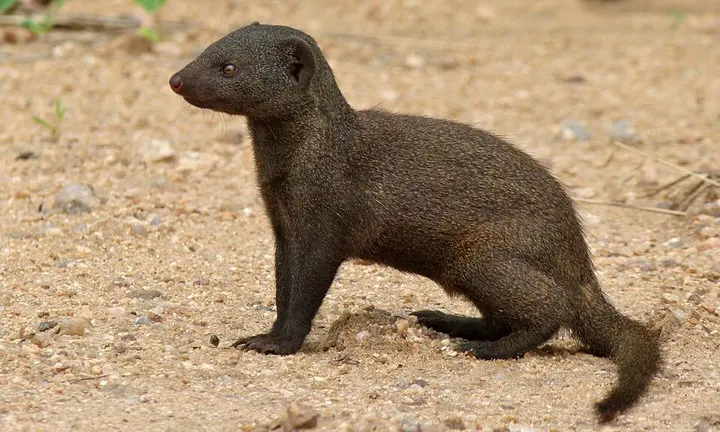
The common dwarf mongoose is a mongoose species native to Angola, northern Botswana, northern Namibia, KwaZulu-Natal in South Africa, Zambia and East Africa. It is part of the genus Helogale, along with the Ethiopian dwarf mongoose.
Appearance
The common dwarf mongoose has soft fur ranging from yellowish red to very dark brown. It has a large pointed head, small ears, a long tail, short limbs and long claws. With a body length of 16–23 cm (6.3–9.1 in) and a weight of 213–341 g (7.5–12.0 oz), it is Africa's smallest member of the order Carnivora.
Behaviour
The common dwarf mongoose is a diurnal animal. The main predators of dwarf mongoose are predatory birds such as raptors and marabou storks, reptiles such as snakes and monitor lizards, and other carnivorous mammals such as jackals and Egyptian mongooses.
Diet
The primary diet of the common dwarf mongoose consists of invertebrates, mainly insects like beetle larvae, termites, grasshoppers, crickets, spiders and scorpions. Secondary food sources include small vertebrates, eggs, and fruit.
Habitat
The common dwarf mongoose ranges from East to southern Central Africa, from Eritrea and Ethiopia to the provinces of Limpopo and Mpumalanga in the Republic of South Africa. It inhabits primarily dry grassland, open forests and bushland up to an elevation of 2,000 m (6,600 ft). It is especially common in areas with many termite mounds, its favorite sleeping place. It avoids dense forests and deserts.
Life cycle
Dwarf mongooses tend to breed during the wet season, between November and May, where the breeding female may produce up to three litters, containing an average of four pups each after a gestation period of 49 to 53 days. The pups nurse for a period of 45 days, during which they may be nursed by subordinate females. Juveniles begin foraging alongside adults at around six weeks of age, and reach sexual maturity at three years of life. Their maximum lifespan is around 18 years.
Where the Common dwarf mongoose lives
Recorded in South Africa, Tanzania, Kenya, Botswana, Uganda, Zimbabwe and Dem. Rep. Congo (Africa).
Most records fall in Mpumalanga, Limpopo, Mara, Rift Valley, Manyara and North-West.
See the Common dwarf mongoose’s range on the globe
Conservation status
Least concern (LC). Not at risk: it is doing well in the wild. Categories are the IUCN Red List as republished by GBIF.
Sources
The range is a density of 2,521 georeferenced GBIF records, shown on the continents where it is mainly recorded, not an expert-drawn map. Description from Wikipedia.