Animals / Mammal
Common duiker
Sylvicapra grimmia · Bovidae
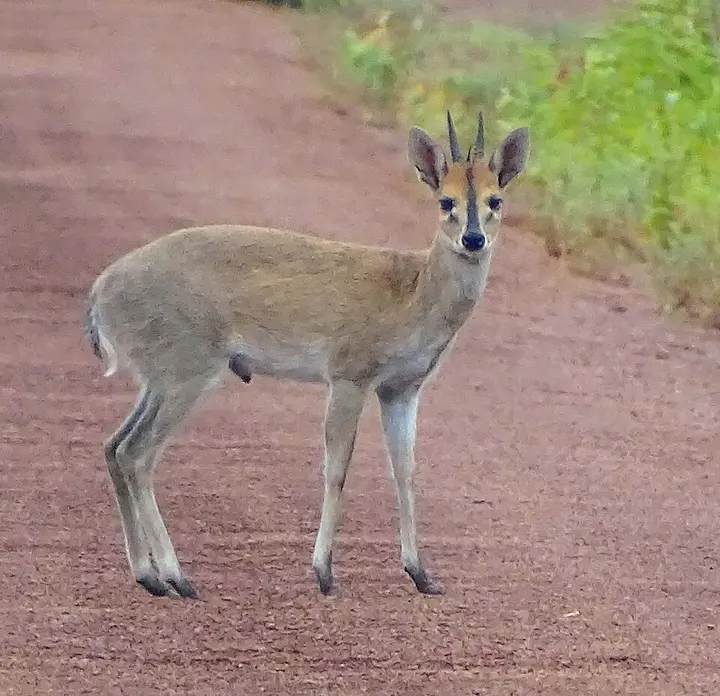
The common duiker, also known as the gray duiker or bush duiker, is a small antelope and the only member of the genus Sylvicapra. This species is found everywhere in Africa south of the Sahara, excluding the Horn of Africa and the rainforests of the central and western parts of the continent. Generally, they are found in habitats with sufficient vegetation cover to allow them to hide—savannah and hilly areas, including the fringes of human settlements.
Appearance
Colouration of this species varies widely over its vast geographic range. There are 14 subspecies described, ranging from chestnut in forested areas of Angola to grizzled gray in northern savannas and light brown shades in arid regions. It grows to about 50 cm (20 in) in height and generally weighs 12 to 25 kg (26 to 55 lb); females are generally larger and heavier than the males. Only the male has horns and these can grow to 11 cm (4.3 in) long.
Behaviour
Breeding is year round and the female gives birth to one fawn after a gestation period of 6 to 7.5 months. The common duiker has a wide diet; beyond browsing for leaves, flowers, fruits and tubers, they will also eat insects, frogs, small birds and mammals, and even carrion. Because the common duiker can eat diverse items, they are able to consume from burnt habitat prior to species that have more restricted diets.
Where the Common duiker lives
Recorded in Benin, South Africa, Zambia, Angola, Kenya and Namibia (Africa).
Most records fall in Atakora, Central, Alibori, Western Cape, KwaZulu-Natal and Limpopo.
See the Common duiker’s range on the globe
Conservation status
Least concern (LC). Not at risk: it is doing well in the wild. Categories are the IUCN Red List as republished by GBIF.
Sources
The range is a density of 10,584 georeferenced GBIF records, shown on the continents where it is mainly recorded, not an expert-drawn map. Description from Wikipedia.