Animals / Bird
Common cuckoo
Cuculus canorus · Cuculidae
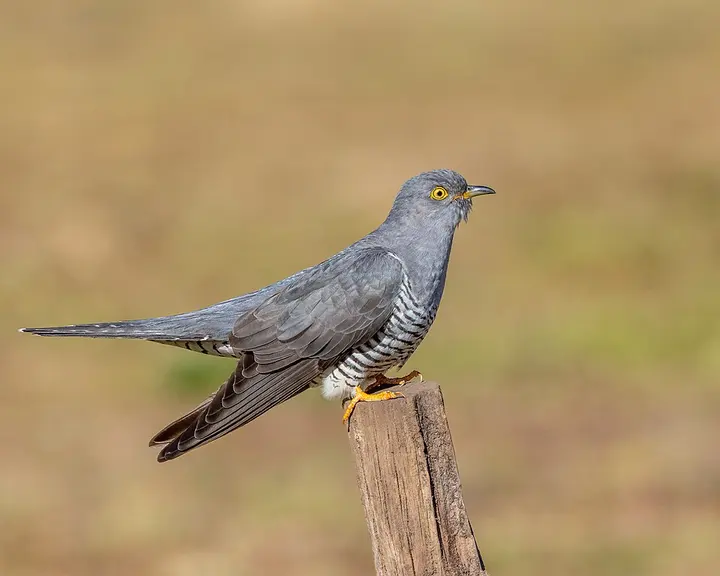
The cuckoo, common cuckoo, European cuckoo or Eurasian cuckoo is a member of the cuckoo order of birds, Cuculiformes, which includes the roadrunners, the anis and the coucals.
This species is a widespread summer migrant to Europe and Asia, and winters in Africa. It is a brood parasite, which means it lays eggs in the nests of other bird species, particularly of dunnocks, meadow pipits, and reed warblers. Although its eggs are larger than those of its hosts, the eggs in each type of host nest resemble the host's eggs. The adult too is a mimic, in its case of the sparrowhawk; since that species is a predator, the mimicry gives the female time to lay her eggs without being attacked.
Appearance
The common cuckoo is 32–34 centimetres (13–13 in) long from bill to tail, with a tail of 13–15 centimetres (5.1–5.9 in) and a wingspan of 55–60 centimetres (22–24 in). The legs are short. It has a greyish, slender body and long tail, similar to a sparrowhawk in flight, where the wingbeats are regular. During the breeding season, common cuckoos often settle on an open perch with drooped wings and raised tail.
Behaviour
The common cuckoo's diet consists of insects, with hairy caterpillars, which are distasteful to many birds, being a specialty of preference. It also occasionally eats eggs and chicks.
Habitat
Essentially a bird of open land, the common cuckoo is a widespread summer migrant to Europe and Asia, and winters in Africa. Birds arrive in Europe in April and leave in September. The common cuckoo has also occurred as a vagrant in countries including Barbados, the United States, Greenland, the Faroe Islands, Iceland, Indonesia, Palau, Seychelles, Taiwan and China.
Life cycle
The common cuckoo is an obligate brood parasite; it lays its eggs in the nests of other birds. Hatched cuckoo chicks push host eggs out of the nest. A female may visit up to 50 nests during a breeding season. Common cuckoos first breed at the age of two years.
Where the Common cuckoo lives
Recorded in Sweden, Netherlands, France, Denmark, United Kingdom, Germany, Spain, Norway, Belgium, Finland, Portugal and Russia (Europe).
Most records fall in Zuid-Holland, Kalmar, Hovedstaden, Skåne, Noord-Holland and Västra Götaland.
See the Common cuckoo’s range on the globe
Conservation status
Least concern (LC). Not at risk: it is doing well in the wild. Categories are the IUCN Red List as republished by GBIF.
Sources
The range is a density of 2,036,882 georeferenced GBIF records, shown on the continents where it is mainly recorded, not an expert-drawn map. Description from Wikipedia.