Animals / Reptile
Common chameleon
Chamaeleo chamaeleon · Chamaeleonidae
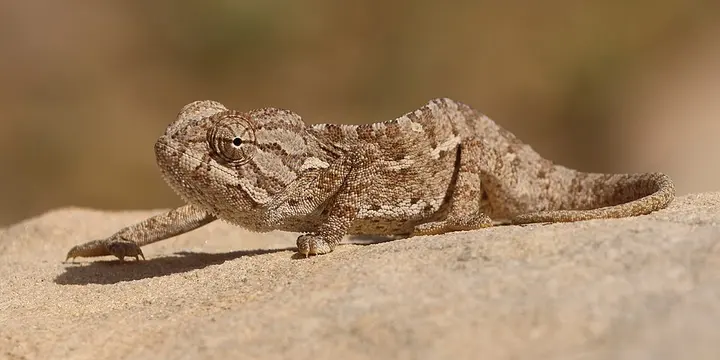
The common chameleon or Mediterranean chameleon is a species of chameleon native to the Mediterranean Basin and parts surrounding the Red Sea. It is the only extant species of Chamaeleonidae with a range that naturally extends into Europe.
Appearance
The average length of the common chameleon is 20–40 cm (8–16 inches), with females often being substantially larger than males. The colour of the common chameleon is variable, between yellow/brown through green to a dark brown. Whatever the background colour is, the common chameleon will have two light coloured lines along its side. It has a small beard of scales and some small hard scales on the top of its back.
Behaviour
The common chameleon is insectivorous, capturing insects by stealth and the rapid extension of its long tongue, which has a terminal pad which grasps and adheres to the prey. Common prey items include flies (Diptera), hymenopterans (Hymenoptera), true bugs (Heteroptera), crickets and grasshoppers (Orthoptera), and beetles (Coleoptera). Adults are known to eat young chameleons and have been observed to eat fruit.
Diet
The common chameleon is insectivorous, capturing insects by stealth and the rapid extension of its long tongue, which has a terminal pad which grasps and adheres to the prey. Common prey items include flies (Diptera), hymenopterans (Hymenoptera), true bugs (Heteroptera), crickets and grasshoppers (Orthoptera), and beetles (Coleoptera). Adults are known to eat young chameleons and have been observed to eat fruit.
Habitat
In Europe, it is only autochthonous to: southern Portugal, southern Spain, southern Italy, Cyprus and the Greek island of Samos. Nevertheless, it has been successfully introduced into the Canary Islands and Malta. In Malta, Jesuit priests are thought to have introduced this species around 1880 in a small private garden in St. Julian's. Since then, this species seems to have flourished and spread across the island, with sightings being reported in Gozo, Malta's sister island.
Life cycle
The common chameleon is usually solitary, maintaining a territory and only tolerating members of the opposite sex during the mating season. It is sexually mature within one year and the females produce one clutch of eggs per year. Larger females produce more eggs and are more attracted to males who will fight over a female. The mating season for the common chameleon is from mid-July to mid-September.
Where the Common chameleon lives
Recorded in Spain, Israel, Portugal, Malta, Morocco, Cyprus and Turkey (Europe, Asia and Africa).
Most records fall in Cádiz, Faro, HaMerkaz, Almería, Alicante and HaZafon.
See the Common chameleon’s range on the globe
Conservation status
Least concern (LC). Not at risk: it is doing well in the wild. Categories are the IUCN Red List as republished by GBIF.
Sources
The range is a density of 7,912 georeferenced GBIF records, shown on the continents where it is mainly recorded, not an expert-drawn map. Description from Wikipedia.