Animals / Bird
Common blackbird
Turdus merula · Turdidae
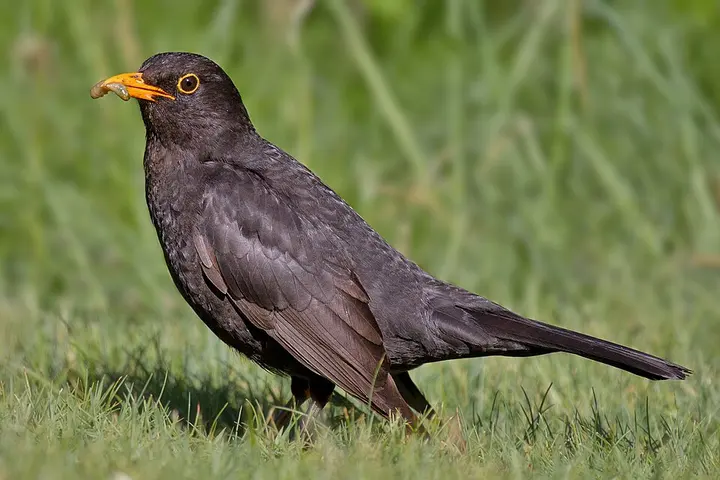
The common blackbird is a species of true thrush. It is also known as the Eurasian blackbird, or simply the blackbird. It breeds in Europe, western Asia, and North Africa, and has been introduced to Australia and New Zealand.
It has a number of subspecies across its large range; a few former Asian subspecies are now widely treated as separate species. Depending on latitude, the common blackbird may be resident, partially migratory, or fully migratory. The adult male of the common blackbird (Turdus merula merula, the nominate subspecies), which is found throughout most of Europe, is all black except for a yellow eye-ring and bill and has a rich, melodious song. The adult female and juvenile have mainly dark brown plumage. This species breeds in woods and gardens, constructing neat, cup-shaped nests bound together with mud. It is omnivorous, eating a wide range of insects, earthworms, berries, and fruits. Both sexes are territorial on the breeding grounds and have distinctive threat displays.
Appearance
The common blackbird of the nominate subspecies T. m. merula is 23.5–29 cm (9.3–11.4 in) in length, has a long tail, and weighs 80–125 g (2.8–4.4 oz). The adult male has glossy black plumage, blackish-brown legs, a yellow eye-ring and an orange-yellow bill. Its bill darkens somewhat in winter. The adult female is sooty-brown with a dull yellowish-brownish bill, a brownish-white throat and some weak mottling on the breast.
Behaviour
The male common blackbird defends its breeding territory by chasing away other males or performing a "bow and run" threat display. This consists of a short run followed by the bird raising its head then bowing it downward with its tail dipped simultaneously. If male blackbirds do fight, it is usually brief and the intruder is quickly chased away. The female blackbird is also aggressive in the spring when competing with other females for a good nesting territory.
Diet
The common blackbird is omnivorous, eating a wide range of insects, earthworms, seeds and berries. It feeds mainly on the ground, running and hopping in a start-stop-start manner. It pulls earthworms from the soil, usually finding them by sight but sometimes also by hearing, and searches through leaf litter for other invertebrates. Small amphibians, lizards and, on rare occasions, small mammals are also occasionally hunted.
Habitat
The common blackbird breeds in temperate Eurasia, North Africa, the Canary Islands, and South Asia. It has also been introduced to Australia and New Zealand. Populations in the south and west of its range are sedentary, although northern birds migrate south as far as northern Africa and tropical Asia in winter.
Where the Common blackbird lives
Recorded in France, United Kingdom, Sweden, Netherlands, Spain, Germany, Norway, Denmark, Portugal, Belgium and Finland (Europe and Oceania).
Introduced, not native, in Ashmore and Cartier Is. and New Zealand.
Most records fall in Victoria, Noord-Holland, Västra Götaland, Stockholm, Hovedstaden and Zuid-Holland.
See the Common blackbird’s range on the globe
Conservation status
Least concern (LC). Not at risk: it is doing well in the wild. Categories are the IUCN Red List as republished by GBIF.
Sources
The range is a density of 13,540,777 georeferenced GBIF records, shown on the continents where it is mainly recorded, not an expert-drawn map. Description from Wikipedia.