Animals / Mammal
Colombian red howler
Alouatta seniculus · Atelidae
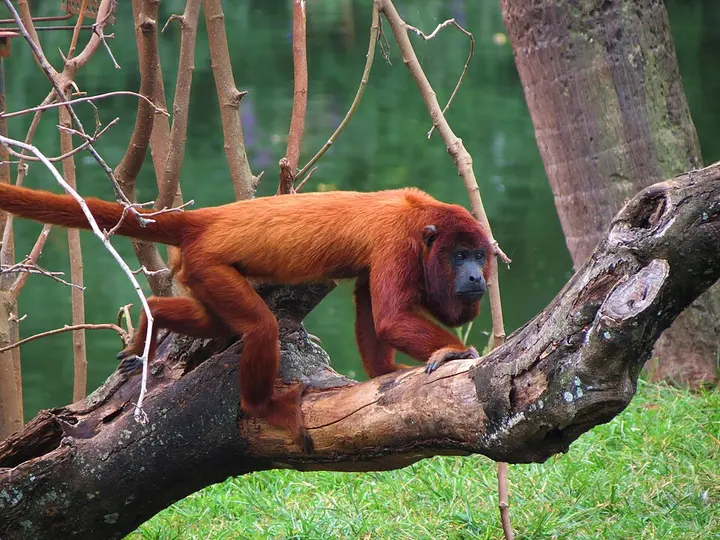
The Colombian red howler or Venezuelan red howler is a South American species of howler monkey, a type of New World monkey, found in the western Amazon Basin in Venezuela, Colombia, Ecuador, Peru and Brazil. The population in the Santa Cruz Department in Bolivia was split off as a separate species, the Bolivian red howler, in 1986, and more recently, splitting off the population in northeastern South America and Trinidad as the Guyanan red howler has occurred. All howler monkeys belong to the family Atelidae and the infraorder Platyrrhini.
Appearance
Sexual dimorphism in this species is small; males range from 49 to 72 cm and females from 46 to 57 cm long. The males weigh 5.4–9 kg, while females weigh 4.2–7 kg. It has a long prehensile tail of 49–75 cm. The tail is covered with fur except for the last third of the underside, which allows it to grab branches. The color of both males and females is a deep reddish-brown, and the color shade changes with age. Their faces are surrounded by fur and they have stubby noses.
Life cycle
The fierce sexual competition between males is due to an unbalanced sex ratio. A female attracts males by moving her tongue around to initiate mating. If the male does not respond, she moves on to another mate. The average gestation period is 190 days. The infant will stay with the mother for 18–24 months. After males reach sexual maturity, they are expelled from their natal group. The male must then invade a foreign group.
Where the Colombian red howler lives
Recorded in Colombia, Ecuador, Peru and Brazil (South America).
Most records fall in La Guajira, Orellana, Meta, Antioquia, Magdalena and Bolívar.
See the Colombian red howler’s range on the globe
Conservation status
Least concern (LC). Not at risk: it is doing well in the wild. Categories are the IUCN Red List as republished by GBIF.
Sources
The range is a density of 7,466 georeferenced GBIF records, shown on the continents where it is mainly recorded, not an expert-drawn map. Description from Wikipedia.