Animals / Fish
Coelacanth
Latimeria chalumnae · Latimeriidae
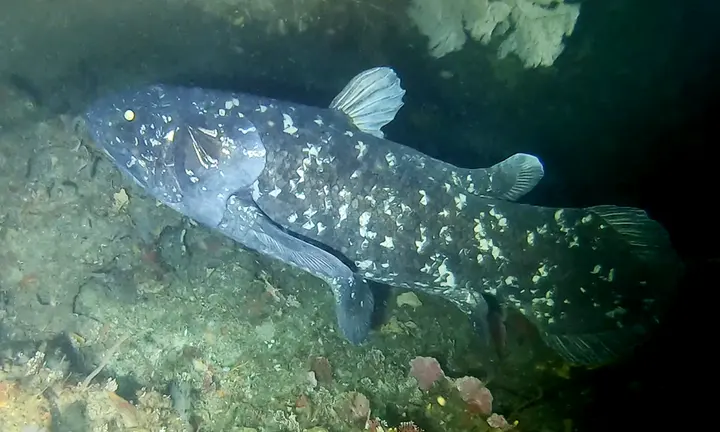
Coelacanths are an ancient group of lobe-finned fish (Sarcopterygii) in the class Actinistia. As sarcopterygians, they are more closely related to lungfish and tetrapods than to ray-finned fish. There is only a single living genus, Latimeria, with two described species.
The name coelacanth originates from the Permian genus Coelacanthus, which was the first scientifically named genus of coelacanths (in 1839), becoming the type genus of Coelacanthiformes as other species were discovered and named. Well-represented in freshwater and marine deposits from as early as the Devonian period (more than 410 million years ago), they were thought to have become extinct in the Late Cretaceous, around 66 million years ago. The first living species, Latimeria chalumnae, the West Indian Ocean coelacanth, was described from specimens fished off the coast of South Africa from 1938 onward; they are now also known to inhabit the seas around the Comoro Islands off the east coast of Africa.
Appearance
Coelacanths are a part of Sarcopterygii or the lobe-finned fishes, the same clade as the lungfish and tetrapods, and they all possess lobed fins as opposed to rayed fins. Externally, several characteristics distinguish coelacanths from other lobe-finned fish: coelacanths have eight fins – two dorsal fins, two pectoral fins, two pelvic fins, one anal fin and one caudal fin.
Behaviour
Living Latimeria coelacanths are nocturnal piscivorous drift-hunters, often drifting in a state of near motionlessness. Species of Latimeria are opportunistic feeders, hunting cuttlefish, squid, snipe eels, small sharks, and other fish found in their deep reef and volcanic slope habitats. Latimeria are also known to swim head down, backwards or belly up to locate their prey. To move around, they most commonly take advantage of up- or down-wellings of current and drift.
Habitat
During the Paleozoic and Mesozoic, coelacanths had a global distribution, with remains having been found on every continent except Antarctica. The two extant Latimeria species, the West Indian Ocean coelacanth and the Indonesian coelacanth, are restricted to the southern and eastern coasts of Africa and northern Indonesia, respectively.
Where the Coelacanth lives
Recorded in Comoros, Tanzania, South Africa, Mozambique and Madagascar (Africa).
Most records fall in Andjazîdja, Tanga, Andjouân, KwaZulu-Natal, Zambezia and Eastern Cape.
See the Coelacanth’s range on the globe
Conservation status
Critically endangered (CR). In very great danger of dying out in the wild. Categories are the IUCN Red List as republished by GBIF.
Sources
The range is a density of 69 georeferenced GBIF records, shown on the continents where it is mainly recorded, not an expert-drawn map. Description from Wikipedia.