Animals / Crustacean
Coconut crab
Birgus latro · Coenobitidae
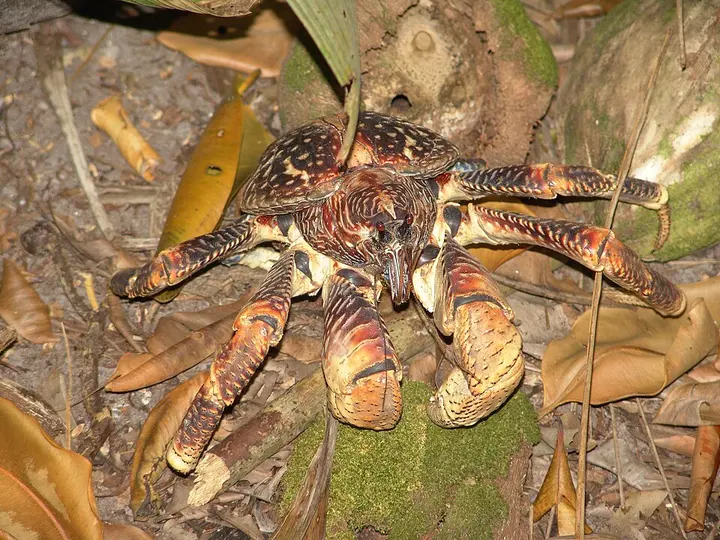
The coconut crab is a terrestrial species of giant hermit crab, and is also known as the robber crab or palm thief. It is the largest living terrestrial arthropod, with a weight up to 4.1 kg. The distance from the tip of one leg to the tip of another can be as wide as 90 centimeters.
It is found on islands across the Indian and Pacific Oceans, as far east as the Gambier Islands, Pitcairn Islands, and Caroline Island, and as far west as Zanzibar. While its range broadly shadows the distribution of the coconut palm, the coconut crab has been extirpated from most areas with a significant human population such as mainland Australia and Madagascar. The coconut crab is the only species of the genus Birgus, and is related to the other terrestrial hermit crabs of the genus Coenobita. It shows a number of adaptations to life on land. Juvenile coconut crabs use empty gastropod shells for protection like other hermit crabs, but the adults develop a tough exoskeleton on their abdomens and stop carrying a shell.
Appearance
B. latro is both the largest living terrestrial arthropod and the largest living terrestrial invertebrate. Reports of its size vary, but most sources give a body length up to 40 cm (16 in), a weight up to 4.1 kg (9 lb), and a leg span more than 0.91 m (3 ft), with males generally being larger than females. The carapace may reach a length of 78 mm (3+1⁄16 in), and a width up to 200 mm (8 in).
Behaviour
The diet of coconut crabs consists primarily of fleshy fruits (particularly Ochrosia ackeringae, Arenga listeri, Pandanus elatus, P. christmatensis); nuts (Aleurites moluccanus), drupes (Cocos nucifera) and seeds (Annona reticulata); and the pith of fallen trees. As they are omnivores, though, they consume other organic materials, such as tortoise hatchlings and dead animals, including other crustaceans, as well as the molted exoskeletons of other crustaceans.
Diet
The diet of coconut crabs consists primarily of fleshy fruits (particularly Ochrosia ackeringae, Arenga listeri, Pandanus elatus, P. christmatensis); nuts (Aleurites moluccanus), drupes (Cocos nucifera) and seeds (Annona reticulata); and the pith of fallen trees. As they are omnivores, though, they consume other organic materials, such as tortoise hatchlings and dead animals, including other crustaceans, as well as the molted exoskeletons of other crustaceans.
Habitat
Coconut crabs live in the Indian and the central Pacific Ocean, with a distribution that closely matches that of the coconut palm. The western limit of the range of B. latro is Zanzibar, off the coast of Tanzania, while the tropics of Cancer and Capricorn mark the northern and southern limits, respectively, with very few populations in the subtropics, such as the Ryukyu Islands.
Where the Coconut crab lives
Recorded in Japan, Taiwan, Fr. Polynesia, Indonesia, Tanzania, Guam, N. Mariana Is., Br. Indian Ocean Ter., Niue, Vanuatu, Marshall Is. and Solomon Is. (Asia, Oceania, Africa and Seven seas (open ocean)).
Most records fall in Okinawa, Taitung, Papua Barat, Windward Islands, Rota and Kaskazini-Pemba.
See the Coconut crab’s range on the globe
Conservation status
Vulnerable (VU). At risk: it could become endangered. Categories are the IUCN Red List as republished by GBIF.
Sources
The range is a density of 1,299 georeferenced GBIF records, shown on the continents where it is mainly recorded, not an expert-drawn map. Description from Wikipedia.