Animals / Mammal
Clouded leopard
Neofelis nebulosa · Felidae
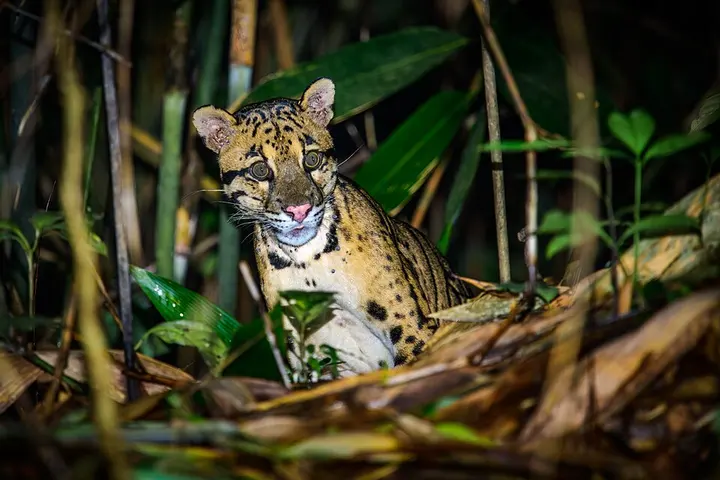
The clouded leopard, also called mainland clouded leopard, is a wild cat that has large dusky-grey blotches and irregular spots and stripes reminiscent of clouds. Its head-and-body length ranges from 68.6 to 108 cm with a 61 to 91 cm long tail, which it uses for balancing when moving in trees.
The clouded leopard was first described in 1821 on the basis of a skin of an individual from China. It is the sister taxon to other pantherine cats, having genetically diverged 9.32 to 4.47 million years ago. It inhabits dense forests from the foothills of the Himalayas through Northeast India and Bhutan to mainland Southeast Asia into South China. It can climb down vertical tree trunks head first, rests in trees during the day and hunts by night on the forest floor. The wild population is thought to be in decline, with fewer than 10,000 adults and no more than 1,000 in any subpopulation. It is locally extinct in Singapore, Taiwan, and possibly also in Hainan Island and Vietnam. It has therefore been listed as Vulnerable on the IUCN Red List since 2008.
Appearance
The clouded leopard's fur is of a dark grey or ochreous ground-color, often largely obliterated by black and dark dusky-grey blotched pattern. There are black spots on the head, and the ears are black. Partly fused or broken-up stripes run from the corner of the eyes over the cheek, from the corner of the mouth to the neck, and along the nape to the shoulders. Elongated blotches continue down the spine and form a single median stripe on the loins.
Behaviour
The clouded leopard is a solitary cat. Early accounts depict it as a rare, secretive, arboreal, and nocturnal inhabitant of dense primary forest. It is one of the most talented climbers among the cats. Captive clouded leopards have been observed climbing down vertical tree trunks head first, and hang on to branches with their hind paws bent around branchings of tree limbs.
Habitat
The clouded leopard occurs from the Himalayan foothills in Nepal, Bhutan and India to Myanmar, southeastern Bangladesh, Thailand, Peninsular Malaysia and to south of the Yangtze River in China. It is locally extinct in Singapore and Taiwan. Clouded leopards were found in Nepal in 1987 and 1988, having previously been presumed to be extinct in the country. Since then, the clouded leopard has been recorded in Shivapuri Nagarjun National Park and in Annapurna Conservation Area.
Life cycle
Both males and females average 26 months at first reproduction. The female is in estrus for about six days, with her estrous cycle lasting about 30 days. In the wild, mating usually occurs between December and March. The pair mates multiple times over the course of several days. The male grasps the female by the neck who responds with vocalization. Occasionally, he also bites her during courtship and is very aggressive during sexual encounters.
Where the Clouded leopard lives
Recorded in Cambodia, India, Thailand, Myanmar, Laos, Indonesia, Malaysia, China, Bangladesh, Bhutan, Vietnam and Nepal (Asia).
Most records fall in Preah Vihéar, Assam, Chhattisgarh, Chiang Mai, Sagaing and Arunachal Pradesh.
See the Clouded leopard’s range on the globe
Conservation status
Vulnerable (VU). At risk: it could become endangered. Categories are the IUCN Red List as republished by GBIF.
Sources
The range is a density of 66 georeferenced GBIF records, shown on the continents where it is mainly recorded, not an expert-drawn map. Description from Wikipedia.