Animals / Mammal
Chimpanzee
Pan troglodytes · Hominidae
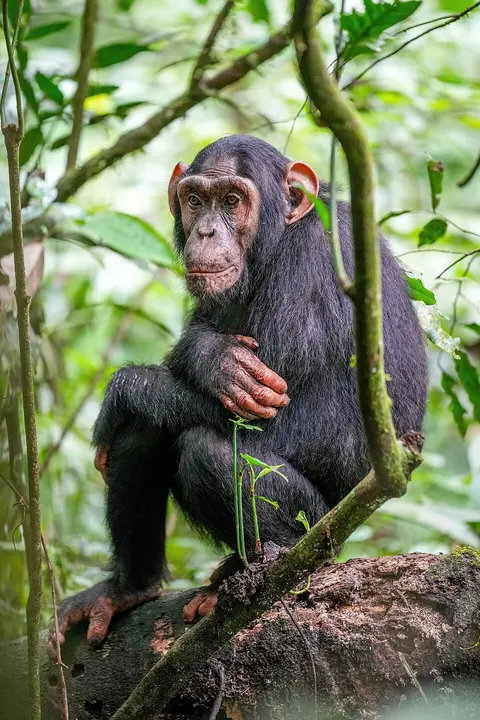
The chimpanzee, commonly abbreviated to chimp, is a medium-sized great ape species found in the forests and savannas of equatorial Africa. It has four confirmed subspecies and a fifth proposed one. The chimpanzee shares the genus Pan with the bonobo.
Evidence from fossils and DNA sequencing shows that the two species are humans' closest living relatives. The chimpanzee is bigger and more robust than the bonobo. It is covered in coarse black hair but has a bare face, fingers, toes, palms of the hands, and soles of the feet. Chimpanzees primarily eat fruit, but will also consume other plant material, as well as insects and will even hunt smaller monkeys. The species lives in groups which can number over 200 members, although individuals travel and forage in much smaller groups during the day. They live in a strict male-dominated hierarchy, where disputes are generally settled without the need for violence. They will sometimes attack other groups for control of resources and mates.
Appearance
Adult chimpanzees have an average standing height of 150 cm (4 ft 11 in). In the wild, males weigh an average of 40 kg (88 lb), while females weigh an average of 30 kg (66 lb). In exceptional cases, certain individuals may considerably exceed these measurements, standing over 168 cm (5 ft 6 in) on two legs and weighing up to 136 kg (300 lb) in captivity. The chimpanzee is more robust than the bonobo but less than the gorilla. Bonobos are also consistently smaller.
Behaviour
Chimpanzees do not directly compete with gorillas in areas where they overlap. At Lopé National Park, gorillas and chimpanzees both will consume fruit when it is abundant, but when it is scarce gorillas eat more vegetation while chimpanzees continue to consume fruit. In addition, gorillas are not as adept at using tools to feed on insects as chimpanzees. While their diets overlap, the two apes also feed on different species, whether fruit or insects.
Diet
The chimpanzee primarily eats fruit, but also consumes leaves, seeds, blossoms, stems, pith, bark, and resin. A study in Budongo Forest, Uganda found that chimpanzees concentrate the majority of their feeding time (64.5%) on fruits (84.6% of which being ripe), particularly those from two species of Ficus, Maesopsis eminii, and Celtis gomphophylla. In addition, 19% of feeding time was spent on arboreal leaves, mostly Broussonetia papyrifera and Celtis mildbraedii.
Where the Chimpanzee lives
Recorded in Tanzania, Uganda, Liberia, Guinea, Central African Rep., Côte d'Ivoire, Cameroon, Gabon and Dem. Rep. Congo (Africa).
Most records fall in Kigoma, Kabarole, Sinoe, Rubirizi, Gbapolu and Kindia.
See the Chimpanzee’s range on the globe
Conservation status
Endangered (EN). In danger of dying out in the wild. Categories are the IUCN Red List as republished by GBIF.
Sources
The range is a density of 4,310 georeferenced GBIF records, shown on the continents where it is mainly recorded, not an expert-drawn map. Description from Wikipedia.