Animals / Mollusc
Chambered nautilus
Nautilus pompilius · Nautilidae
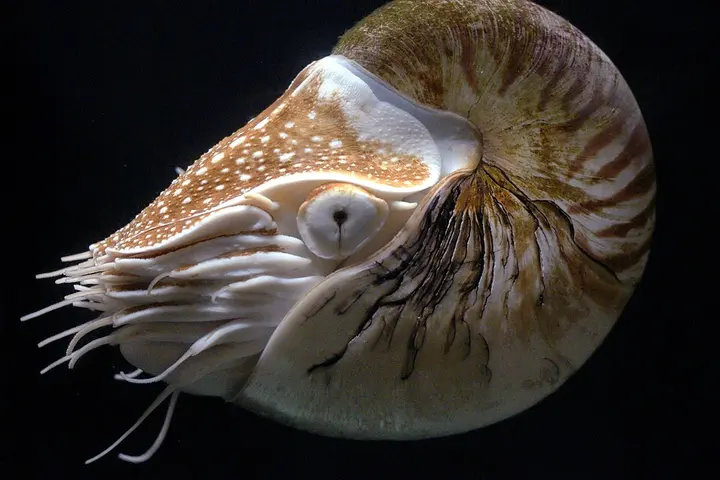
The chambered nautilus, also called the pearly nautilus, is the best-known species of nautilus. The shell, when cut away, reveals a lining of lustrous nacre and displays a nearly perfect equiangular spiral, although it is not a golden spiral. The shell exhibits countershading, being light on the bottom and dark on top.
This is to help avoid predators, because when seen from above, it blends in with the darkness of the sea, and when seen from below, it blends in with the light coming from above. The range of the chambered nautilus encompasses much of the south Pacific; It has been found near reefs and on the seafloor off the coasts of Australia, Japan, and Micronesia. The eyes of the chambered nautilus, like those of all Nautilus species, are more primitive than those of most other cephalopods; the eye has no lens and thus is comparable to a pinhole camera. The species has about 90 cirri (referred to as "tentacles"; see Nautilus § Tentacles) that do not have suckers, differing significantly from the limbs of coleoids.
Diet
As a carnivore, it feeds on both underwater carrion and detritus, as well as living shellfish and crab. Mainly scavengers, chambered nautiluses have been described as eating "anything that smells". This food is stored in a stomach-like organ known as a crop, which can store food for a great deal of time without it denaturing.
Life cycle
Because of their oceanic habitat, studies of their life cycle have primarily been based on captive animals and their eggs have never been seen in the wild. Although nautilus have been kept at public aquariums since the 1950s, the chambered nautilus was first bred in captivity at the Waikiki Aquarium in 1995 (a couple of other nautilus species had been bred earlier) and captive breeding remains a rare event even today.
Where the Chambered nautilus lives
Recorded in Ashmore and Cartier Is. (Oceania).
Most records fall in Western Australia, New South Wales and Queensland.
See the Chambered nautilus’s range on the globe
Conservation status
Vulnerable (VU). At risk: it could become endangered. Categories are the IUCN Red List as republished by GBIF.
Sources
The range is a density of 11,441 georeferenced GBIF records, shown on the continents where it is mainly recorded, not an expert-drawn map. Description from Wikipedia.