Animals / Mammal
Chacma baboon
Papio ursinus · Cercopithecidae
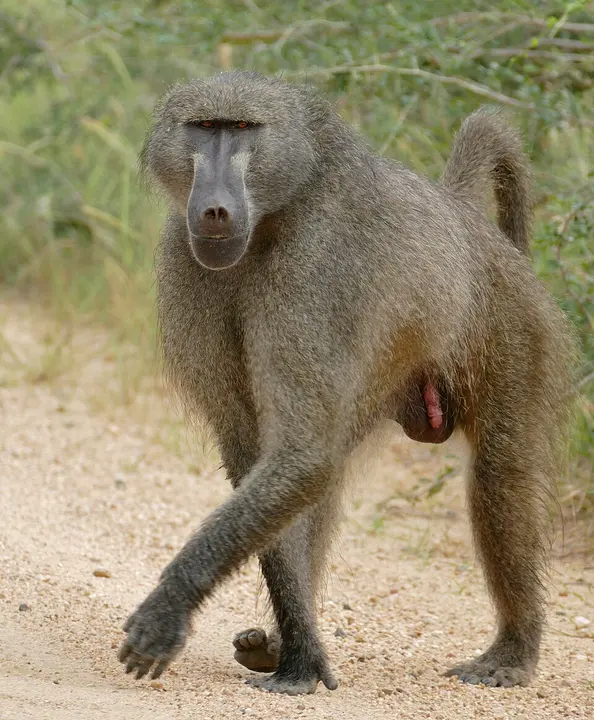
The chacma baboon, also known as the Cape baboon, is, like all other baboons, from the Old World monkey family. It is one of the largest of all monkeys. Located primarily in southern Africa, the chacma baboon has a wide variety of social behaviours, including a dominance hierarchy, collective foraging, adoption of young by females, and friendship pairings.
These behaviors form parts of a complex evolutionary ecology. In general, the species is not threatened, but human population pressure has increased contact between humans and baboons. Hunting, trapping, and accidents kill or remove many baboons from the wild, thereby reducing baboon numbers and disrupting their social structure.
Appearance
The chacma baboon is perhaps the longest species of monkey, with an adult body length of 50 to 115 cm (20 to 45 in) and tail length of 45 to 84 cm (18 to 33 in). It is also one of the heaviest; the male weighs from 21 to 45 kg (46 to 99 lb) with an average of 31.8 kg (70 lb). Baboons are sexually dimorphic, and females are considerably smaller than males. The adult female chacma weighs from 12 to 25 kg (26 to 55 lb), with an average of 15.4 kg (34 lb).
Behaviour
The chacma baboon inhabits a wide array of habitats including woodland, savanna, steppes, and sub desert, from the grassy alpine slopes of the Drakensberg to the Kalahari Desert. During the night, the chacma baboon sleeps atop steep hills, high cliffs or rocks or in large trees, away from nocturnal predators. In daytime, water availability may limit its range in arid areas.
Diet
The chacma baboon is an omnivorous highly opportunistic feeder, and will eat practically anything; typical foods include fruits, seeds, grass, blossoms, bulbs, bark, insects, spiders, worms, grubs, rodents, birds, small antelope and fungi (the desert truffle Kalaharituber pfeilii). Chacma baboon diet is thought to contain about 2 percent animal-sourced food, most of which consists of invertebrates; proportions vary between populations.
Habitat
The chacma baboon inhabits a wide array of habitats including woodland, savanna, steppes, and sub desert, from the grassy alpine slopes of the Drakensberg to the Kalahari Desert. During the night, the chacma baboon sleeps atop steep hills, high cliffs or rocks or in large trees, away from nocturnal predators. In daytime, water availability may limit its range in arid areas.
Life cycle
Chacma baboons do not have a specific breeding season; they breed through the year. On average, males and females reach sexual maturity around 5 years, but males typically don't breed successfully until they are large enough to challenge other males, around 7 to 10 years old. Mothers give birth on average every 1.5 to 2 years and usually have only one infant at a time. It takes about one year for those infants to reach independence.
Where the Chacma baboon lives
Recorded in South Africa, Namibia, Botswana, Zimbabwe and Zambia (Africa).
Most records fall in Western Cape, Mpumalanga, Limpopo, KwaZulu-Natal, North-West and Eastern Cape.
See the Chacma baboon’s range on the globe
Conservation status
Least concern (LC). Not at risk: it is doing well in the wild. Categories are the IUCN Red List as republished by GBIF.
Sources
The range is a density of 12,042 georeferenced GBIF records, shown on the continents where it is mainly recorded, not an expert-drawn map. Description from Wikipedia.