Animals / Reptile
Central bearded dragon
Pogona vitticeps · Agamidae
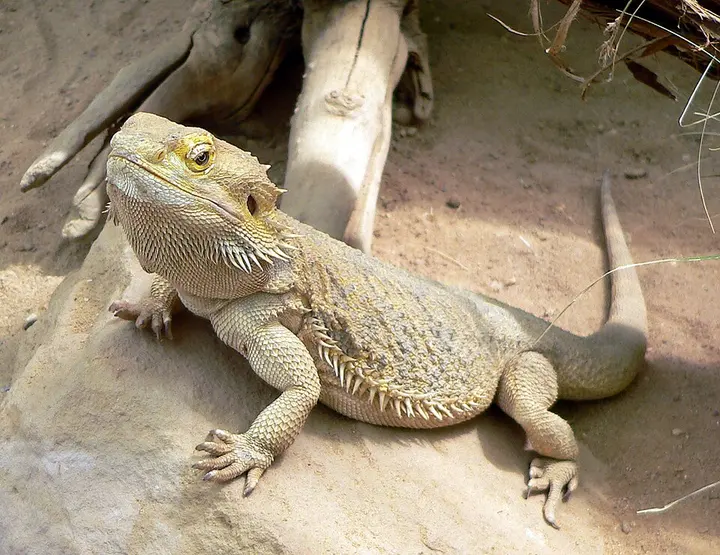
The central bearded dragon, also known commonly as the inland bearded dragon, is a species of lizard in the family Agamidae. The species is native to eastern and central Australia. Its common name refers to the pouch under their chin that they can inflate and darken in coloration, similar to the frilled lizard.
The bearded dragon grows to around up to 60 cm (24 in) from head to tail tip and can weigh 550 g (1.2 lb). Males are generally larger than females. The lizard's body is generally brown, tan, yellow, and red.
Appearance
Mature bearded dragons can reach a total length of around 60 cm (24 in), or two feet, with the tail accounting for more than half of that. Some sexual dimorphism is present, as males can be distinguished from females by a wider cloacal opening, a wider tail-base, a larger and more angular head, a more developed beard (guttural throat-pouch), and the obvious possession of hemipenes.
Behaviour
P. vitticeps is native to semiarid woodland, arid woodland, and rocky desert areas of Central Australia, primarily the inland regions of New South Wales, Northern Territory, Queensland and South Australia. They are skilled climbers and often spend just as much time perching and basking on tree limbs, fence posts, and within bushes as they do on the ground.
Life cycle
The age of sexual maturity has not been measured, although it is estimated to be about one or two years. Body size and growth rates are more important than age when determining sexual maturity in bearded dragons. Males will become very aggressive towards each other and will assert their dominance by inflating their beards and through fast head bobbing. Breeding typically occurs in the early spring.
Where the Central bearded dragon lives
Recorded in Ashmore and Cartier Is. (Oceania).
Most records fall in South Australia, New South Wales, Northern Territory, Queensland, Victoria and Australian Capital Territory.
See the Central bearded dragon’s range on the globe
Conservation status
Least concern (LC). Not at risk: it is doing well in the wild. Categories are the IUCN Red List as republished by GBIF.
Sources
The range is a density of 9,084 georeferenced GBIF records, shown on the continents where it is mainly recorded, not an expert-drawn map. Description from Wikipedia.