Animals / Bird
Cedar waxwing
Bombycilla cedrorum · Bombycillidae
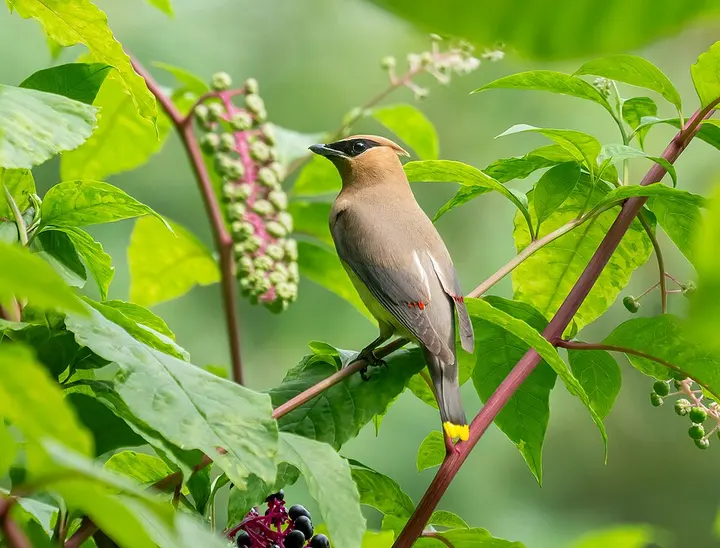
The cedar waxwing is a member of the family Bombycillidae or waxwing family of passerine birds. It is a medium-sized bird that is mainly brown, gray, and yellow. Some of the wing feathers have red tips, which resemble sealing wax, giving the bird its common name.
It is a native of North and Central America, breeding in open wooded areas in southern Canada and wintering in the southern half of the United States, Central America, and the far northwest of South America. Its diet includes cedar cones, fruit, holly berries, and insects. The cedar waxwing is listed as least concern on the IUCN Red List.
Appearance
Cedar waxwings are medium-sized birds around 6–7 in (15–18 cm) long and weighing roughly 30 g (1 oz). Wingspan ranges from 8.7 to 11.8 in (22 to 30 cm). They are smaller and browner than their close relative, the Bohemian waxwing (which breeds farther to the north and west). Their markings are a "silky, shiny collection of brown, gray, and lemon-yellow, accented with a subdued crest, rakish black mask, and brilliant-red wax droplets on the wing feathers."
Behaviour
The two common calls of these birds include very high-pitched whistles and buzzy trills about a half-second long, often represented as see or sree. Its call can also be described as "high, thin, whistles." They call often, especially in flight.
Diet
Cedar waxwings eat berries and sugary fruit year-round, including dogwood, serviceberry, cedar, juniper, hawthorn, and winterberry, with insects becoming an important part of the diet in the breeding season. Their fondness for the small cones of the eastern redcedar (a kind of juniper) gave these birds their common name. They eat berries whole. They sometimes fly over water to catch insects.
Life cycle
The mating season for this bird begins around the end of spring and runs through to late summer. The male does a "hopping dance" for the female. If she is interested, she will hop back. During courtship, the male and female sit together and pass small objects back and forth, such as flower petals or an insect. Mating pairs sometimes rub their beaks together.
Where the Cedar waxwing lives
Recorded in United States of America and Canada (North America).
Most records fall in New York, Ontario, California, Québec, Pennsylvania and Texas.
See the Cedar waxwing’s range on the globe
Conservation status
Least concern (LC). Not at risk: it is doing well in the wild. Categories are the IUCN Red List as republished by GBIF.
Sources
The range is a density of 7,257,091 georeferenced GBIF records, shown on the continents where it is mainly recorded, not an expert-drawn map. Description from Wikipedia.